Zhongqing Robotics and Transformer have recently entered into an in-depth strategic cooperation and jointly launched the Humanoid Robot Astronaut Exploration Program. With PM01, the embodied general intelligent agent independently developed by Zhongqing Robotics, as the core carrier, the two parties will jointly conduct mission verification for the space environment.
This marks the first domestic application of a humanoid robot system in space exploration scenarios, and also an important interdisciplinary integration of embodied intelligence technology and aerospace engineering.
Cooperative Project Launch & Core Carrier Introduction
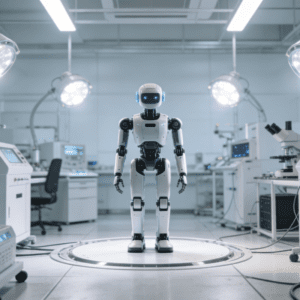
As the core robot platform of Zhongqing Robotics, PM01 is equipped with a high-precision environmental perception system based on multi-sensor fusion, a millisecond-level real-time motion control module, and a decision-making and planning system built on independent algorithms. It is capable of perceiving, judging and executing continuous tasks in dynamic environments. The robot has completed multiple rounds of high-load and high-complexity technical verifications on the ground. This attempt at application for space means its technology stack will face the direct test of harsh conditions such as vacuum, microgravity, extreme temperatures and radiation.
Technical Capabilities & Complementary Advantages
The space environment places far higher demands on the reliability and autonomy of robots than ground scenarios. This cooperation between the two parties is based on their long-accumulated technological complementarity: Zhongqing Robotics has built up strong expertise in robotic motion control, complex environment adaptation and embodied intelligence algorithms; Transformer boasts rich practical experience in aerospace engineering and the ability to adapt to space mission scenarios. Multiple rounds of joint simulation and risk assessment have been conducted in the preliminary stage of the cooperation.
In aerospace missions, the robot can undertake tasks such as extravehicular inspections, equipment maintenance and hazardous environment detection, alleviating the operational load and risks for astronauts. At the same time, the extreme space environment also provides a high-level verification field for the reliability and robustness of embodied intelligence systems, and relevant technical feedback is expected to drive the iterative upgrade of ground industrial applications. In the long run, the “human-robot collaboration” model will become an important support for building a sustainable space operation system.
Mission Value & Future Development Outlook
Going forward, the technical teams of both parties will focus on the adaptation transformation of PM01 for the space environment, the optimization of on-orbit mission algorithms and the improvement of system reliability, and gradually advance the project’s transition from ground verification to the space experiment phase. This cooperation is also regarded as a substantive step forward for the cross-border collaboration between China’s intelligent robot and aerospace fields.