From barrel to sterile seal — fully automated, audit-ready, and built for the 14.5% CAGR explosion in global syringe demand.
The $18 Billion Question Hanging Over Every Syringe Manufacturer
The numbers are staggering. The global syringe market was valued at $10.64 billion in 2026 and is projected to reach $15.09 billion by 2034 — while the automatic syringe assembly machine market alone is expected to climb from $8.09 billion in 2025 to over $18 billion by 2033, growing at an astonishing 14.5% CAGR.
But growth alone does not guarantee success. The prefilled syringes segment — the fastest-growing category — is accelerating even faster at a 10.9% CAGR, expected to reach $14.53 billion by 2031. For every syringe manufacturer racing to capture this demand, one brutal arithmetic holds true:
If your assembly line cannot keep up, someone else‘s will.
A conventional manual syringe assembly line employs six to eight workers per shift. Together, they produce roughly 800 to 1,200 units per hour. The defect rate runs between 3% and 5% — misaligned plungers, poorly seated gaskets, improperly capped barrels. Each defect means rework, wasted material, and — in the worst cases — regulatory findings that can delay shipments or trigger costly audits.
Now multiply that inefficiency across three shifts. Across six days a week. Across an entire year. The cumulative cost is not a line item. It is a competitive disadvantage.
Enter RuiZhi‘s Syringe Automatic Assembly Equipment — the fully automated line that transforms manual chaos into predictable, scalable, compliant production.
From Six Workers to One Machine: The Math That Changes Everything
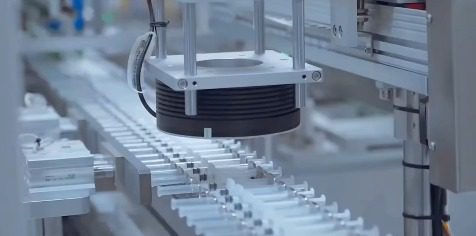
RuiZhi’s fully automated syringe assembly equipment consolidates the entire assembly workflow into a single, continuous, synchronized process. Barrel feeding → plunger insertion → gasket seating → needle hub attachment → cap tightening → online inspection → finished product sorting. Every step is automated. Every parameter is monitored. Every unit is tracked.
| Metric | Manual Assembly Line | RuiZhi Automated Line |
|---|---|---|
| Operators per shift | 6–8 | 1–2 |
| Output per hour | 800–1,200 units | 2,000–3,000+ units |
| Positioning accuracy | ±0.1–0.3 mm | ±0.02 mm |
| First-pass yield | 95–97% | >99.5% |
| Defect rate | 3–5% | <1.5% |
| Labor cost reduction | — | 70% |
| Model changeover | Hours | <20 minutes |
One RuiZhi machine replaces six to eight manual operators per shift. Two technicians manage the entire line. Production scales without hiring, training, or managing more people. That is not just automation — that is industry‑scale leverage.
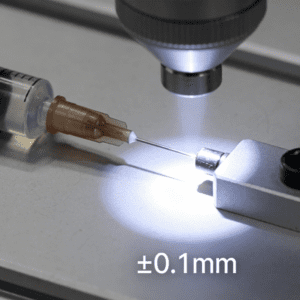
±0.02 mm servo‑driven positioning accuracy is not a specification. It is the difference between a plunger that seals perfectly and one that leaks — between a syringe that passes every audit and one that triggers a recall.
FDA QMSR 2026 Is Here. Is Your Syringe Line Ready?
On February 2, 2026, the FDA‘s Quality Management System Regulation (QMSR) took full effect — rewriting the quality compliance framework for every medical device manufacturer in the United States. ISO 13485:2016 is now the core quality management benchmark for syringe production, mandating fully traceable, audit-ready assembly processes with closed‑loop documentation.
The old ways are no longer sufficient. Spreadsheets and handwritten logs do not constitute compliance. Paper-based quality checks and disconnected manual stations cannot produce the audit‑ready digital trail that regulators now expect.
RuiZhi‘s syringe assembly equipment is engineered with compliance at its core:
-
MES integration from the ground up — Every assembly parameter (insertion force, applied torque, seal integrity) is automatically logged, timestamped, and stored
-
FDA 21 CFR Part 11 compliance — Electronic records and signatures meet the highest standards for data integrity
-
EU MDR and ISO 13485 alignment — Full traceability for manufacturers exporting to global markets
-
GMP‑ready cleanroom design — Built with materials and configurations that meet stringent hygiene requirements
When an auditor asks to see batch records, you do not scramble to compile paper forms. You pull the data. Instantly. Compliance is not an afterthought — it is engineered into every cycle.
AI‑Powered Vision: The Quality Inspector That Never Blinks
In 2026, AI is no longer a future concept in medical device manufacturing — it is a present reality. AI is maturing into a necessary tool for vision inspection, detecting minute defects on microscopic parts that standard rule‑based vision might miss. The goal is no longer just to detect defects — it is to catch them before they occur.
RuiZhi‘s syringe assembly equipment integrates AI‑powered visual inspection as a standard feature. High-resolution cameras inspect each component at every station — verifying alignment, detecting surface imperfections, measuring dimensional accuracy, and rejecting faulty units before they progress further.
This closed‑loop quality control embodies the principles of Industrial IoT (IIoT) and real‑time quality management. For syringe manufacturers serving the $13.06 billion pharmaceutical packaging equipment market — projected to grow at 12.1% CAGR — AI vision is no longer a luxury. It is the new operational baseline.
Flexible Manufacturing for a Multi‑SKU World
Syringe designs are anything but uniform. Luer slip. Luer lock. Safety syringes. Auto‑disable. Prefilled. Different sizes, materials, needle gauges, and customer specifications. On a manual line, switching between these configurations takes hours — sometimes an entire shift — and introduces new opportunities for error.
On the RuiZhi system, modular tooling and parameter memory reduce changeover time to under 20 minutes. Store configurations for dozens of SKUs. Recall any setup with a few taps on the touchscreen HMI. Switch production runs without costly downtime.
This flexibility is essential for manufacturers responding to rapid market shifts, seasonal demand spikes, and the growing trend toward personalized and specialty syringe configurations. One line. Dozens of variants. No expensive retooling.
The 2026 Regulatory Landscape: Why Manual Lines Are No Longer an Option
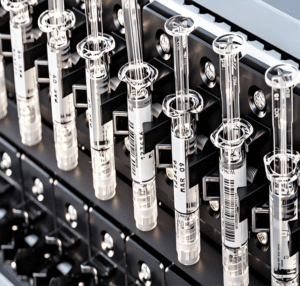
The compliance pressure on syringe manufacturers has never been higher — and 2026 is the year it becomes unignorable.
United States: The FDA’s QMSR now aligns 21 CFR Part 820 with ISO 13485:2016 for the first time. Inspections are no longer just about documenting procedures — they require affirmative evidence of a robust, self‑correcting quality culture. For combination products such as prefilled syringes, manufacturers are subject to both drug CGMP and medical device QMSR requirements, demanding an integrated, data‑driven approach to compliance.
European Union: From May 28, 2026, the use of four core EUDAMED modules becomes mandatory for all economic operators — manufacturers, authorized representatives, importers, and notified bodies — demanding end‑to‑end product traceability and audit‑ready documentation for every device placed on the EU market.
Manual assembly lines with inconsistent quality and incomplete traceability are no longer just inefficient. They are a regulatory liability. RuiZhi’s MES‑integrated, fully traceable syringe assembly equipment turns compliance from a headache into a competitive advantage.
The Workforce Reality: Automate Before Your Competitors Do
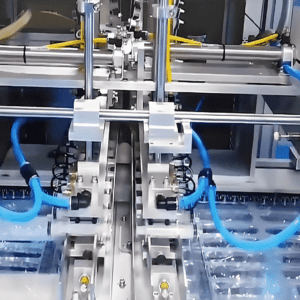
The labor challenge facing medical device manufacturing is not cyclical — it is structural. The global medical automation market, valued at $63.93 billion in 2025, is projected to reach $137.14 billion by 2032, growing at an 11.51% CAGR. Yet while 98% of manufacturers are exploring AI‑driven automation, only 20% say they feel fully prepared to use it at scale.
The gap between early adopters and laggards is widening. And in syringe manufacturing, falling behind on automation means falling behind on quality, compliance, and the ability to win contracts.
RuiZhi’s syringe assembly equipment delivers 70% labor cost reduction compared to manual lines. Two operators achieve what six to eight could not. Production scales without hiring. Quality improves without additional training. Compliance strengthens without manual paperwork.
That is not speculation. That is the arithmetic of automation.
Real ROI, Real Fast
The business case for syringe assembly automation has never been clearer:
-
Labor: 70% reduction in direct labor costs — six to eight operators replaced by two
-
Throughput: 2,000–3,000+ units per hour versus 800–1,200 units manual — a 2.5× to 3.75× increase
-
Quality: First‑pass yield >99.5% — defect rate below 1.5% — less rework, less waste, fewer returns
-
Compliance: MES‑integrated audit trails — FDA QMSR, EU MDR, ISO 13485, and 21 CFR Part 11 ready
-
Flexibility: Changeover under 20 minutes — run dozens of SKUs on one line
-
Payback: Typically 8–14 months for medium‑volume syringe manufacturers
For contract manufacturers serving the global syringe market — expanding from $10.64 billion in 2026 toward $15.09 billion by 2034 — automation is not a cost. It is the only way to stay competitive.
Built for the Industry 4.0 Syringe Factory
The syringe manufacturing facility of 2026 is intelligent, connected, and data‑driven. RuiZhi‘s syringe assembly equipment is Industry 4.0 ready from the ground up:
-
IoT sensors enable predictive maintenance and real‑time performance monitoring
-
MES integration provides full production traceability and regulatory reporting
-
Real‑time analytics help you optimize throughput and quality continuously
The equipment supports 24‑hour uninterrupted production, with cleanroom‑ready design and compliance with ISO 13485, GMP, and 21 CFR Part 11. When your competitors‘ manual lines are changing shifts, your RuiZhi line is still running. That is the power of Industry 4.0 in syringe manufacturing.
Trusted by Medical Device Manufacturers — Ready for You
Since 2014, RuiZhi Intelligent Manufacturing has delivered custom, non‑standard automatic assembly solutions to the global medical device industry. Our Syringe Automatic Assembly Equipment combines:
-
±0.02 mm servo‑driven precision — for flawless plunger insertion and seal integrity
-
AI‑powered visual inspection — for real‑time defect detection and quality assurance
-
MES‑integrated traceability — for FDA QMSR, EU MDR, and ISO 13485 compliance
-
Modular flexible tooling — for sub‑20‑minute changeovers across dozens of SKUs
-
70% labor cost reduction — for rapid payback and scalable production
➡️ Contact RuiZhi Automation today to request a quote or schedule a virtual demo.
#SyringeAssemblyEquipment #MedicalDeviceAutomation #FDAQMSR #Industry40 #PharmaceuticalManufacturing