
On November 27, the off-grid demonstration project of integrated source-grid-load-storage zero-carbon hydrogen storage at Jiading Hydrogen Energy Port in Shanghai was broadcast live on China Central Television (CCTV). As China’s first zero-carbon energy system to achieve a full “electricity-hydrogen-electricity” closed loop, it has attracted widespread attention for its innovative technologies and remarkable benefits.
It is understood that this demonstration project is Shanghai’s first full-closed-loop zero-carbon hydrogen storage project integrating source, grid, load and storage, with a core logic analogous to a “zero-carbon power bank”. Based on a 1.4-megawatt photovoltaic power generation system, the project captures solar energy through rooftop photovoltaic panels and converts it into electricity. To address the pain point of unstable photovoltaic power output, it adopts a coordinated operation mode of PEM and ALK electrolyzers to split water into hydrogen and oxygen. This setup not only adapts to instantaneous changes in light intensity, but also ensures the stability of large-scale hydrogen production. The produced hydrogen is stored in high-pressure hydrogen storage tanks, solving the problem that traditional energy storage methods struggle to retain energy on a large scale for long periods. When electricity demand arises, the fuel cell system generates power through the chemical reaction of hydrogen and oxygen, emitting nothing but water vapor throughout the process and thus achieving a zero-carbon cycle.
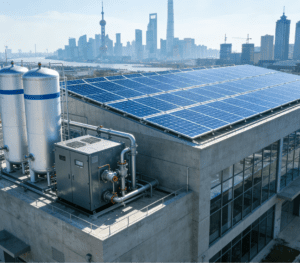
The project has an annual hydrogen production capacity of 27.5 tons (approximately 300,000 standard cubic meters) and an annual green power generation capacity of around 510,000 kilowatt-hours, which can meet the annual electricity demand of 300 households. Moreover, it can reduce carbon dioxide emissions by more than 1,400 tons per year, equivalent to planting 80,000 trees. Relying on Shanghai’s municipal-level supportive policies covering the entire “hydrogen production, storage, transportation, refueling and utilization” industrial chain, as well as supporting measures such as a 15% investment subsidy in Jiading District, the “Hydrogen Energy Port Model” will promote the nationwide expansion of hydrogen energy applications. It is planned to build more than 10 comprehensive hydrogen energy stations across China by 2026. Notably, as a benchmark carrier for the integration of high-end manufacturing and new energy industries in Shanghai, the technological innovation spillover effect of Jiading Hydrogen Energy Port has also radiated to the surrounding precision manufacturing field. For instance, the high-precision automated control technology developed for the coordinated operation of electrolyzers and fuel cell systems has provided technical references for the upgrading of Syringe Automatic Assembly Equipment and other medical device manufacturing equipment, helping related industries achieve more efficient and stable production processes and forming a sound ecology of coordinated development between new energy and high-end manufacturing.