

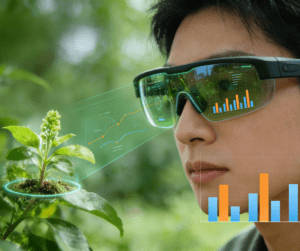
What if a seemingly ordinary pair of glasses could instantly translate foreign language texts in front of your eyes, provide real-time smart navigation for drivers, or even take photos and videos of the scenery you see? This is no longer the stuff of sci-fi movies. The year 2025 marks the “boom” of AI smart glasses, with numerous enterprises launching a variety of AI smart glass products one after another. The author has compiled a roundup of current AI smart glasses; let us now step into the world of AI smart glasses together.
Li Auto: Livis
On December 3rd, Li Auto officially launched its first AI glasses product, Livis, achieving a cross-industry breakthrough from the intelligent vehicle sector to the AI smart glasses domain.
At the launch event, Fan Haoyu, Senior Vice President of Li Auto’s Product Department, stated, “Based on our technological accumulation in assisted driving, spatial intelligence, and AI, Li Auto has been exploring forms of smart devices that can naturally and continuously accompany users. Glasses are worn for long periods daily and do not require users to change their habits, making them the most natural interactive gateway available today.”
According to official information, Livis is a multi-functional AI glasses product weighing only 36 grams, with a continuous battery life of 18.8 hours under simulated daily usage scenarios. It supports a range of smart operations including taking photos, playing music, and even remote vehicle control. With a simple voice command like “move forward” or “back up”, the car can maneuver itself out of a parking space. Currently, Li Auto officially refers to Livis as its “most powerful accessory”. Notably, the seamless integration of hardware and software in Livis is enabled by an advanced Universal Assembly System, which ensures precise alignment of core components—from sensors to microprocessors—during production, supporting both the device’s ultra-lightweight design and millisecond-level response speeds, with instantaneous photo capture taking just 0.7 seconds.
Alibaba: Quark AI Glasses S1
On November 27th, Alibaba’s first self-developed AI glasses—the Quark AI Glasses S1—was officially released and opened for pre-order. Positioned as a smart wearable device, the Quark AI Glasses S1 focuses on practical features such as the Amap near-eye navigation system, Alipay “glance-to-pay” function, Taobao product recognition and price comparison, and Fliggy travel reminders.
In terms of design, the temple arms and frame are crafted to be ultra-slim, with internal components and lenses manufactured using special processes, giving the glasses a transparent appearance indistinguishable from ordinary frames.
For navigation scenarios, the R&D team collaborated with Amap to develop a near-eye display navigation system tailored for AI glasses, enabling precise guidance during mobility scenarios such as cycling and walking, thus realizing true near-eye navigation.
In terms of payment functionality, the Quark AI Glasses S1 has partnered with Alipay to launch the “glance-to-pay” feature. The payment process is simple and intuitive: users just need to glance at the payment QR code and initiate payment via voice command or a light touch on the temple arm. Leveraging bone conduction voiceprint recognition technology, the glasses can complete identity verification, allowing transactions to be finished in the blink of an eye.
With its innovative screenless interactive design, deep integration with the Alibaba ecosystem, diverse practical functions, and multiple cutting-edge technological breakthroughs, the Quark AI Glasses S1 brings new excitement to the smart wearable industry and unlocks new possibilities for intelligent lifestyle experiences.
Xiaomi Corporation: Xiaomi AI Glasses
On June 26th, at Xiaomi’s “Human-Vehicle-Home Full Ecosystem” launch event, the company’s first AI glasses made its official debut.
Lei Jun commented that the Xiaomi AI Glasses are a “personal smart device for the next era” and a portable AI gateway. Once worn, users can directly ask Xiaoai Classmate about anything they see, and Xiaoai Classmate will provide real-time responses with answers.
Whether it is an unfamiliar flower by the roadside, an unknown bird flying across the sky, or even the calorie content of the food in front of you, Xiaoai will deliver quick and accurate answers.
In terms of video recording, the Xiaomi AI Glasses support first-person perspective shooting, which offers a highly immersive viewing experience—a standout feature of its recording capability. Suitable for a wide range of daily life scenarios, it enables the “see-and-share” experience instantly.
Author’s Conclusion
AI smart glasses are transitioning from science fiction to reality. As leading enterprises such as Li Auto, Alibaba, and Xiaomi roll out their new products one after another, these devices have evolved from simple wearables into intelligent sensory hubs that integrate navigation, recognition, payment, and interaction. From Livis’ remote vehicle control and Quark’s near-eye navigation to Xiaomi’s instant Q&A function, all these innovations signal that AI is integrating into daily life in a more natural and seamless manner.
In the future, when we can connect to everything and gain insight into the world simply by putting on a pair of glasses, technology will no longer be a cold tool but an extension of human perception and action. An era of human-centric, virtual-real integrated intelligent interaction has quietly arrived.