Traffic Police Equipped with AI Glasses: Adding “Intelligent Wings” to Traffic Law Enforcement
Tech Empowers Law Enforcement: AI Glasses Deployed in Multiple Cities
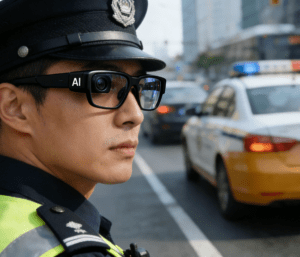
This AI smart glasses is equipped with a 12-megapixel ultra-high-definition wide-angle camera and an intelligent predictive anti-shake algorithm, ensuring clear images during dynamic law enforcement. With an 8-hour continuous working time, it fully meets the needs of all-day law enforcement duties.
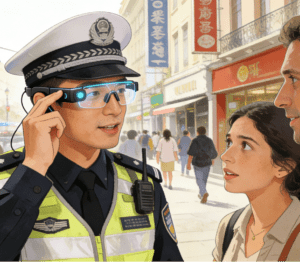
When on-duty traffic police put on this pair of seemingly ordinary black-framed glasses, they can instantly complete license plate recognition and reservation information verification with just a glance at passing vehicles. When encountering inquiries from foreign tourists, a light touch on the frame enables real-time multilingual translation — a “future law enforcement” scenario once seen only in science fiction has now become a reality on the streets of Changsha, Hangzhou, Guangzhou and many other cities. The quiet deployment of AI smart glasses is reshaping the traffic law enforcement model with technological power, injecting new vitality into urban traffic management.
Core Capabilities: Cutting-Edge Tech Behind AI Law Enforcement Glasses
As a product of the deep integration of technology and traffic law enforcement, AI smart glasses are by no means simple “technological accessories”, but rather “law enforcement tools” integrated with a variety of cutting-edge technologies. Adopting a lightweight integrated design, the glasses are equipped with a 12-megapixel ultra-high-definition wide-angle camera and paired with an intelligent predictive anti-shake algorithm, enabling stable collection of first-person view high-definition images and videos even in low-light environments. Its core advantage lies in the seamless connection between front-end perception and back-end data. Through core functions such as offline license plate recognition and face recognition, it can quickly capture target information within a range of 2 to 7 meters, and conduct millisecond-level comparison with back-end databases including scenic spot reservation systems, event vehicle pass databases and vehicle management systems, with verification results fed back within 1 to 2 seconds. This efficient “glance-to-identify, second-level result” mode has completely changed the time-consuming and labor-intensive predicament of manual verification in traditional law enforcement.
Transformative Value: Enhancing Efficiency & Fairness in Traffic Management
The application value of AI smart glasses is particularly prominent in scenarios such as scenic spot traffic control and large-scale event security. After Changsha Orange Isle Scenic Area implemented the vehicle reservation access policy, the traditional manual license plate verification method often caused bridge congestion during peak hours. In contrast, when police officers wear AI smart glasses on duty, they can complete reservation information verification just by looking at the vehicles — reserved vehicles can “pass with a glance”, while non-reserved ones receive a red light reminder. This has increased the single-lane traffic efficiency by 80%, reducing congestion complaints to zero during the National Day holiday. Hangzhou West Lake Scenic Area has also benefited greatly from this technology. During the National Day holiday, Li Yuwei, the “Rabbit Police Officer” wearing domestically developed AI smart glasses, was able to complete “West Lake Pass” reservation data verification from 5 to 7 meters away, shortening the original 3-to-5-second (or even longer) verification process to just 1 to 2 seconds, effectively alleviating traffic pressure at the scenic area entrance. During the Guangzhou 15th National Games, AI smart glasses even achieved 1-second verification of accredited vehicles, directly reducing police deployment by 30% and ensuring smooth traffic at the event entrances.
In addition to improving traffic efficiency, AI smart glasses also play an important role in optimizing law enforcement services and standardizing law enforcement procedures. In tourist cities with frequent foreign exchanges, the real-time voice translation function of the glasses serves as a “communication bridge” — Chinese guidelines spoken by police officers can be instantly converted into broadcasts in more than 10 commonly used foreign languages such as English, Japanese and Korean, solving the language barrier when dealing with foreign tourists’ inquiries. Meanwhile, its contactless law enforcement mode greatly reduces the risk of law enforcement conflicts; traffic police can complete inspections without intercepting vehicles, while simultaneously managing traffic flow and responding to inquiries. More importantly, the glasses can record law enforcement videos throughout the process and store them in encrypted form, not only providing a complete chain of evidence for law enforcement procedures, but also effectively addressing some car owners’ doubts about “selective clearance”, thus safeguarding the fairness of law enforcement.
The application of AI smart glasses has endowed traffic law enforcement with both rigor and humanistic care. Amid the wave of technological empowerment, such “sci-fi law enforcement” scenarios are taking root in more and more cities, making traffic management more intelligent and efficient, and demonstrating the essence of technology serving people’s livelihoods by safeguarding the smoothness and safety of every journey.
EIR Sichuan Embodied Technology’s Robotic Dog Successfully Completes 10.3km Utility Tunnel Autonomous Inspection Mission
Project Milestone: Ultra-Long-Distance Autonomous Inspection Achieved in Southwest China’s Utility Tunnels
Recently, the Lingtong L3P robotic dog developed by EIR Sichuan Embodied Humanoid Robot Technology Co., Ltd. (hereinafter referred to as EIR), integrated with the company’s self-developed intelligent inspection platform, was successfully deployed in a 10.3km comprehensive utility tunnel. It achieved ultra-long-distance autonomous inspection, creating the first benchmark application case of its kind in Southwest China.
As the first utility tunnel project in Southwest China to realize 10km-level ultra-long-distance autonomous inspection, the project adopts a core integrated solution of “human-robot collaboration + AI intelligent inspection platform”. It effectively addresses the long-term operation and maintenance challenges of enclosed utility tunnels, marking another major breakthrough for EIR in the application of intelligent equipment in complex scenarios.
As a core urban infrastructure, the utility tunnel is equipped with fire doors and features a harsh operating environment characterized by no GPS signal, narrow and humid space, and dense high-voltage lines. These conditions render traditional manual inspection inefficient, high-risk, and incomplete in coverage.
Core Capabilities: Robotic Dog Performance & AI Inspection Platform Support
Equipped with multi-modal perception fusion and autonomous decision-making algorithms, the Lingtong L3P robotic dog delivers the following capabilities:
– Autonomous linkage control of fire doors, identifying and triggering door opening and closing
– Centimeter-level high-precision navigation
– Automatic obstacle avoidance
– Full-route blind-spot-free inspection and continuous operation
Meanwhile, all inspection data is transmitted in real time to the AI intelligent inspection platform via a private network, forming dynamic health profiles for the tunnel. This enables early detection, early warning, and early disposal of potential hazards.
In addition, the platform provides 3D spatial visualization management, one-click task distribution, and automatic inspection report generation, establishing a complete digital inspection closed loop. Supported by dual modes of autonomous charging and emergency battery replacement, the device can meet the demand for 24/7 uninterrupted inspection, significantly reducing labor input and operational costs.
Transformative Impact & Future Outlook for Intelligent Inspection
The implementation of this project has effectively driven the transformation of underground space inspection mode from “periodic spot checks” to “full-process real-time monitoring”.
Inspection coverage and anomaly detection rates have been substantially improved, while the frequency of personnel entering high-risk areas has been significantly reduced. This comprehensively enhances the safety, continuity, and digitalization level of utility tunnel operation and maintenance.
Currently, EIR’s universal inspection solution built around the Lingtong L3P has been successfully applied in multiple fields including high-end security, emergency rescue, and industrial inspection, serving benchmark clients in public security, fire protection, and power sectors. Notably, in the industrial inspection scenario of medical device production workshops equipped with Thermometer visual labeling machines, the Lingtong L3P robotic dog can conduct autonomous patrols, real-time monitor the working status of the labeling machines, detect abnormal labeling deviations and environmental parameter fluctuations that affect product quality, and synchronize data to the intelligent platform for early warning, ensuring the stability and precision of the thermometer labeling process. Its strong adaptability to diverse scenarios has been fully verified.
Furthermore, Sichuan Embodied Technology is leading the construction of the Sichuan Humanoid Robot Training Ground. In the future, the company will continue to focus on technological R&D in complex scenarios and talent cultivation, providing technical support and demonstration leadership for the development of the intelligent equipment industry.
The successful completion of this utility tunnel project not only provides a replicable “Sichuan Intelligent Manufacturing integrated solution” for underground space operation and maintenance, but also demonstrates Sichuan Embodied Technology’s strong capability in empowering urban infrastructure upgrading with independent core technologies.
Going forward, the company will continue to deepen innovation in robotics technology, promote the implementation of more intelligent solutions, and contribute to the safe and efficient operation of cities.