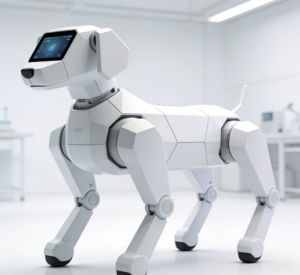
On December 23, Vitas Dynamics officially launched and opened pre-sales for its first intelligent companion robot, Bobo the Big Head, with the first batch of products expected to be delivered sequentially starting from March 2026.
Unlike the mainstream quadruped robot dogs currently on the market, Bobo the Big Head’s biggest highlight is that it truly achieves autonomous movement and intelligent interaction through body intelligence, spatial intelligence and Agent intelligence – without the need for remote control operations.
From “Controlled Machine” to “Autonomous Companion”: Bobo’s Three-Fold Intelligent Breakthroughs
Vitas Dynamics’ definition of the “next-generation robot” lies in a three-layer architecture of “body intelligence, spatial intelligence and Agent intelligence”. And Bobo the Big Head’s core competitiveness lies in its subversive advancements in all three capabilities compared to existing consumer-grade robot dogs.
Body Intelligence: All-Terrain Performance + Long Battery Life, Solving the “Usability” Foundation
As the robot’s “small brain”, body intelligence is the key to determining whether a robot can operate stably in complex environments such as homes and outdoors.
In this crucial capability, Bobo the Big Head breaks the industry’s inertia of “prioritizing performance over practicality”. It adopts a 1:1 ratio design of upper and lower legs, with a single leg length of 22 cm. Compared with the maximum step height of 20 cm specified in national, American and European standards, this design forms a more stable triangular support structure.
To support more complex movements, Vitas Dynamics has independently developed the N45 high-performance permanent magnet joint motor, reducing the weight of a single motor to 0.4 kg – a 20% weight reduction compared with similar products in the industry – while achieving a maximum torque of 24.5 N·m. It is reported that a single Bobo the Big Head is equipped with 12 such motors. Based on this, Bobo can reach a top speed of 13.3 km/h – equivalent to a marathon pace of 4 minutes and 30 seconds per kilometer – carry a load of 12 kg, and even tow objects weighing up to 100 kg.
Considering that battery life anxiety is another major pain point for consumer-grade robots, Bobo the Big Head is also equipped with a 594Wh integrated battery. The official claims that its comprehensive battery life can reach 5 hours, a significant improvement compared with the 1–3 hour battery life of current mainstream products in the industry.
To achieve this, Bobo the Big Head has made three important adjustments in its overall design:
– Abandoning the industry’s commonly used “battery compartment replacement” solution to allocate more space to battery cells;
– Learning from the E/E architecture of smart cars, integrating multiple ECUs into a single computing platform to reduce the space occupied by multiple controllers;
– Adopting battery cells with higher energy density, ultimately increasing battery capacity by an additional 30% on top of the industry’s optimal level.
In addition, targeting home scenarios, Vitas Dynamics has adopted human-centric design elements such as fully rounded body edges, joint protection nets and mechanical limiters to enhance safety during interactions with people and objects in home environments. To further ensure electrical safety, the core circuit system of Bobo is equipped with high-precision fuses, which are assembled by an advanced Fuse Assembly Machine to achieve automated and precise installation, effectively preventing risks such as circuit overload and short circuit.
It must be said that these details may seem trivial, but they are essential prerequisites for robot dogs to enter households.
Spatial Intelligence: 128TOPS Computing Power + Full-Scenario Perception, Achieving the Core of “Route Recognition”
If body intelligence ensures that Bobo the Big Head “can run”, spatial intelligence focuses on enabling it to “run smartly” – which is also the key to Bobo’s “remote-control-free” functionality.
To achieve reliable and stable operation across all terrains, Bobo the Big Head is equipped with a 360° lidar, 360° UWB positioning system, a spatial four-microphone array, and binocular depth-sensing cameras on its head. Moreover, it supports two-degree-of-freedom rotation (left/right, up/down) of the head, further expanding the perception range.
Matching its excellent perception capabilities is a high-end side AI computing power of up to 128TOPS. For reference, the computing power of flagship-level robot vacuum cleaners and drones in 2025 is about 10TOPS, high-end smartphones about 40TOPS, and even educational robot dogs priced at nearly 90,000 yuan only have a computing power of 40–100TOPS. With 128TOPS of on-device computing power, Bobo the Big Head can perform real-time environmental understanding and perception without relying on network connectivity.
Supporting this powerful computing capability is Digua Robotics’ S100P chip. This “brain” integrates 1,164 high-precision components on a single computing platform, supports dual power supply of 48V for motors and 12V for electronic devices, and is even equipped with a 240W high-power Type-C interface.
To enable the robot dog to “understand routes”, Vitas Dynamics has also developed the first full-scenario spatial foundation model, which allows Bobo the Big Head to process complex physical environment information and achieve autonomous navigation, obstacle avoidance and intelligent following.
Agent Intelligence: From “Playmate” to “Task Performer”, Meeting Real Household Needs
As the “professional skill library”, Agent intelligence determines whether a robot dog can truly be “useful”. Bobo the Big Head is positioned as “the first physical space Agent for households”, with its core scenarios centered around three major needs: companionship, guidance and item fetching.
In the live demonstration at the launch event, Bobo the Big Head was able to accurately identify passable areas on paths covered with fallen leaves and overgrown with trees, stably follow the target, and relock the target after it was temporarily blocked by tree trunks. Furthermore, Bobo can respond to commands such as “go to the café”, navigate autonomously and remind the user to “watch your step”.
For the item fetching scenario, Bobo the Big Head’s all-purpose expansion backplane supports magnetic storage baskets, 1/4 screw ports and trailer hooks, and is even compatible with robotic arms, enabling scenario applications such as picking up takeaways, disposing of garbage, mounting cameras and pulling camping carts.
Why a Robot Dog? Vitas Dynamics’ Pragmatic Logic
At the launch event, Zhao Zhelun, Co-founder of Vitas Dynamics, raised a core question: “There are already many robot dogs on the market, so why do we need to make another one?”
The answer lies in a dual consideration of industry pain points and the genetic advantages of the Vitas Dynamics team.
According to Zhao Zhelun, before starting the business, Vitas Dynamics tested almost all mainstream robot dogs on the market and discovered a common problem: most of them are stuck at the “body intelligence” stage – users can only control them to run and jump with a remote control; they cannot understand the environment (i.e., lack spatial intelligence) nor complete tasks independently (i.e., lack Agent intelligence).
Focusing on this market pain point, coupled with the development of technologies such as end-to-end AI technical architecture and world models, it has become possible to equip robot dogs with preliminary spatial intelligence. Vitas Dynamics hopes to seize this technological window to bring robotic capabilities previously confined to laboratories or the high-end education market to household users at a consumer-grade price and with a consumer-grade experience.
It is worth noting that the core team of Vitas Dynamics has a dual gene of “technology + user-centricity”, which also lays the foundation for the “pragmatism” of its products.
Yu Yinan, Founder and CEO of Vitas Dynamics, is the former Vice President of Horizon Robotics and one of its early founding team members. Song Wei, Co-founder, once served as the Chief Architect of the Software Platform at Horizon Robotics. Another Co-founder, Zhao Zhelun, used to be the Director of Intelligent Driving Products at Li Auto.
Autonomous driving cars are often metaphorically referred to as “robots on four wheels”, and the two fields share high commonality in core technologies such as environmental perception and decision-making planning. This means that the Vitas Dynamics team can transfer its experience in large-scale mass production and artificial intelligence technologies in the field of intelligent driving to robot R&D, thus forming a unique competitive advantage.
Currently, with the launch and pre-sale of Bobo the Big Head, Vitas Dynamics is about to face its real market test. According to Zhao Zhelun, Bobo the Big Head is scheduled to enter public beta delivery in January 2026, with mass delivery starting in March.
Going forward, as the public beta delivery of Bobo the Big Head draws near, whether this robot dog can truly win the recognition of household users remains to be seen in the market. But what is certain is that when robots start to break free from remote controls and learn to “recognize routes, perform tasks and provide companionship”, the “daily integration” of embodied intelligence is no longer a distant concept.
Industrial assembly contractor for Original Equipment Manufacturers