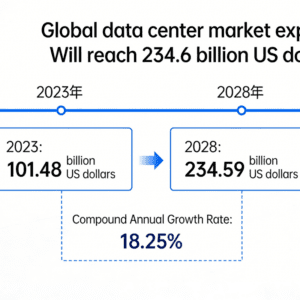
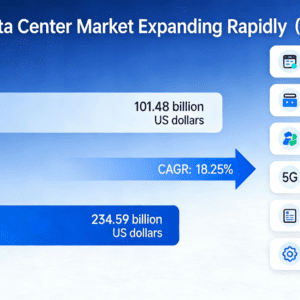
The deepening global digital transformation is driving the data center services market into a phase of rapid expansion. As enterprises increase their investments in cloud computing, big data analytics, artificial intelligence, and the Internet of Things (IoT), the demand for high-performance, scalable, and secure data processing infrastructure continues to grow. In 2023, the global data center services market was valued at approximately $101.48 billion, and it is projected to surge to around $234.59 billion by 2028, representing a compound annual growth rate (CAGR) of 18.25%. This article provides a systematic analysis of the industry from the perspectives of growth drivers, market constraints, and long-term development prospects.
Drivers of Market Growth
Accelerated Technological Iteration and Deepened Digital Transformation
Accelerated technological innovation is a key force fueling the expansion of the data center services market. The widespread application of technologies such as artificial intelligence, machine learning, big data analytics, and edge computing has raised higher demands for computing power, storage capacity, and network architecture.
Meanwhile, the digital transformation of various industries is advancing steadily, leading to a rapid increase in enterprises’ reliance on IT infrastructure. This trend drives organizations to deploy more efficient, scalable data centers with enhanced processing capabilities to support the digital upgrade of business systems, intelligent operations, and data-driven decision-making.
Growing Demand for Global Connectivity and Widespread Adoption of Cloud Computing
Enterprises worldwide are increasingly dependent on cross-regional collaboration, data sharing, and online services. Coupled with the maturity of cloud computing models, data centers have become critical infrastructure.
Cloud computing delivers data and application services online, reducing enterprises’ need to build on-premises IT infrastructure and thus spurring a substantial rise in demand for data centers that support cloud environments with high availability, high throughput, and low latency. As enterprises continue to migrate their digital assets and business systems to the cloud, the foundational supporting role of data centers will be further strengthened.
Rising Requirements for Energy Efficiency and Sustainable Development
Against the backdrop of global carbon emission control and green transition, the high energy consumption of data centers has attracted widespread attention. Newly built data centers are accelerating the adoption of energy-efficient equipment, high-performance cooling technologies, and renewable energy sources to reduce environmental impact and operational costs.
The construction of green data centers has gradually become an industry development trend and an important way for enterprises to fulfill their social responsibilities and meet regulatory requirements.
5G Commercial Deployment Boosts the Development of Edge Computing
The popularization of 5G networks has significantly improved data transmission speed and network capacity, enabling the implementation of numerous low-latency-sensitive applications such as autonomous driving, smart cities, and high-performance IoT devices.
To meet the real-time and computing requirements of these new scenarios, the demand for edge computing has grown rapidly, driving the deployment of data processing nodes closer to users or data sources, thereby fueling the construction of edge data centers and the growth of related services.
Popularization of Remote Working Models
The global prevalence of remote working has forced enterprises to build secure and stable IT environments to support remote access, collaboration, and data transmission. This has accelerated the application of VPNs, cloud collaboration tools, and virtualization services, and simultaneously boosted the demand for data center infrastructure.
Steady Surge in Data Generation
Internet services, e-commerce, online media platforms, and IoT devices generate massive volumes of data every day. The scale of data generated by enterprises and individuals on digital platforms is growing exponentially, requiring larger-scale storage capacity and more efficient data processing architectures.
This drives the continuous expansion of data centers to meet the increasing demand for data storage, management, and analysis.
Key Market Constraints
Regulatory and Compliance Pressures
The tightening of data protection and privacy regulations has imposed more compliance requirements on data center operations. There are significant differences in legal frameworks across countries and regions; for example, the EU’s GDPR and the US’s HIPAA both set stringent rules for data storage, processing, and access.
For cross-border service providers, the coexistence of multiple regulations increases business complexity, and non-compliance risks may lead to financial losses and reputational damage.
Site Selection Restrictions
The construction of data centers has strict requirements for power stability, network access, geographic security, climatic conditions, and proximity to customers. The scarcity of ideal locations poses great challenges for the site selection of new data centers.
To address this challenge, the industry has begun to adopt modular data centers and edge data center solutions close to the user side to improve flexibility and deployment efficiency.
High Construction and Operational Costs
Data center construction requires substantial capital investment, including land acquisition, infrastructure construction, power systems, cooling equipment, and operation and maintenance teams. Meanwhile, data centers are highly dependent on electricity, with energy costs accounting for a significant proportion of operational expenses.
The high entry barrier limits the ability of small and medium-sized enterprises to enter the market and also places financial pressure on existing enterprises during expansion.
Shortage of Technical Professionals
Modern data centers involve specialized fields such as network management, cloud service architecture, cybersecurity, and system management, leading to a sustained increase in demand for technical talents. However, the insufficient supply of industry talents has made it more difficult to recruit and retain technical staff, affecting the expansion and operational efficiency of data centers.
Enterprises have to invest more resources in internal training and talent development, thereby increasing cost burdens.
Escalating Cybersecurity Risks
As core data storage and processing facilities, data centers face an increasing number of sophisticated cyber attacks, such as ransomware, DDoS attacks, and data leakage incidents.
Service providers need to continuously enhance their security protection, monitoring, and emergency response capabilities to protect sensitive data and maintain business continuity. However, such investments are often costly and complex.
Environmental Impact and Sustainability Pressures
The high energy consumption of data centers has raised concerns about their environmental impact. Both regulatory authorities and corporate customers have put forward higher requirements for carbon emission reduction.
Improving energy efficiency, adopting renewable energy, and building green data centers have become inevitable directions for the industry, but the high cost of such investments may create additional pressure.
Future Outlook
Overall, the global data center services market will maintain a strong growth momentum in the coming years. The core drivers of market expansion include the accelerated digital transformation, widespread adoption of cloud services, development of intelligent technologies, and the continuous surge in global data storage demand. Meanwhile, with the extensive implementation of 5G and edge computing, the architecture and layout of data centers will tend to be more distributed, intelligent, and efficient.
Nevertheless, the industry still faces multiple challenges such as high costs, compliance complexity, cybersecurity risks, and sustainability pressures. To ensure long-term growth, data center providers need to continue investing in the following areas:
Promote the construction of green data centers and improve energy efficiency
Strengthen cybersecurity and risk management systems
Enhance the level of automated and intelligent operation and maintenance
Cultivate and attract high-end technical talents
Strengthen global layout and differentiated service capabilities
Through sustained investments in technological innovation, security, and sustainable development, the industry will be able to meet the growing digital demand and provide a robust infrastructure support for the long-term development of the global economy.