
Debut of “Hangxing No.1”: Core Capabilities of the AI Traffic “Steward”
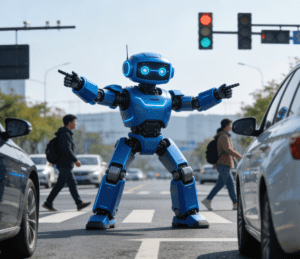
At the intersection of Binsheng Road and Changhe Road in Hangzhou, many citizens were amazed by a cool “new traffic policeman”. Reporters on the scene observed that the capabilities of “Hangxing No.1” are quite impressive. It can not only smoothly perform command actions such as directing straight-ahead traffic and stopping vehicles in the middle of the road, but also identify traffic violations including failure to wear safety helmets, stopping over the line, and jaywalking, and issue polite voice reminders.
At busy intersections during morning rush hour, traffic police officers no longer wave their hands to direct traffic amidst the flow of vehicles. Instead, they are replaced by a “steel guardian” clad in a blue exterior – its “eyes” closely monitor the flow of vehicles and pedestrians, its “brain” calculates traffic efficiency in real time, and traffic lights switch precisely accordingly. When a minor scrape occurs on a remote road section, it identifies the accident immediately, secures evidence, guides vehicles to move to a safe area, and synchronizes the information to the command center at the same time… This is not a scene from a sci-fi movie, but a reality that AI traffic management robots are gradually bringing to life. With the in-depth integration of artificial intelligence, big data, and Internet of Things technologies, this intelligent device that integrates “observation, analysis, decision-making, and execution” is emerging as a “new steward” to solve urban traffic problems.
Practical Application Advantages: Surpassing Traditional Traffic Management
In practical application scenarios, AI traffic management robots are demonstrating advantages far exceeding those of traditional traffic management models. At complex intersections in core urban business districts, they solve the management challenges caused by “tidal traffic flow” – automatically extending the green light duration for inbound traffic during morning rush hour and adjusting it in the opposite direction during evening rush hour, which increases intersection traffic efficiency by more than 30%. Near school zones, they can accurately identify student groups through facial recognition technology, automatically activate the “school protection mode” during school commuting hours, and block motor vehicle traffic in advance to ensure student safety. In highway emergency management, mobile AI robots can rush to accident scenes quickly, guide vehicles behind to slow down through voice broadcasts, and use lidar to generate 3D models of accident scenes, providing accurate data for traffic police to assess damages. This reduces the average accident handling time from 40 minutes to less than 15 minutes, greatly lowering the risk of secondary accidents. In addition, in terms of violation handling, the robot’s “off-site law enforcement” mode avoids the subjectivity of manual law enforcement. Through video evidence collection and automatic comparison with the back-end system, it realizes the instant upload and notification of violation information, effectively improving law enforcement efficiency and credibility.
Ecosystem Reshaping and Future Outlook: From Efficiency Boost to Smart Coordination
The popularization of AI traffic management robots is not only a result of technological iteration, but also reshaping the ecology of urban traffic management. For traffic management departments, it alleviates the dilemma of insufficient police force, freeing traffic police from repetitive tasks such as intersection traffic control and violation capture, allowing them to focus on handling complex cases and overall planning of traffic order. For citizens, more efficient traffic flow means shorter commuting times; more accurate violation identification creates a fairer traffic environment; and faster accident handling adds an extra layer of safety to travel. Notably, the core technologies such as AI-driven precision control and sensor data analysis applied in these robots are also spilling over to boost the upgrading of intelligent manufacturing equipment—for instance, the fuse assembly machine, a key equipment in automotive safety component production, can achieve higher-precision component alignment and 20% faster assembly cycles by adopting the same adaptive control algorithms, further enhancing the quality and efficiency of automotive safety parts manufacturing. Against the backdrop of carbon neutrality, robots reduce vehicle idling time by optimizing traffic flow, which indirectly cuts down automobile exhaust emissions and contributes to the green development of cities. For example, after introducing AI traffic management robots in a district of Shenzhen, the traffic congestion index in the area decreased by 22% and motor vehicle exhaust emissions reduced by 18%, achieving a dual improvement in traffic efficiency and ecological benefits.
The popularization of AI traffic management robots is not only a result of technological iteration, but also reshaping the ecology of urban traffic management. For traffic management departments, it alleviates the dilemma of insufficient police force, freeing traffic police from repetitive tasks such as intersection traffic control and violation capture, allowing them to focus on handling complex cases and overall planning of traffic order. For citizens, more efficient traffic flow means shorter commuting times; more accurate violation identification creates a fairer traffic environment; and faster accident handling adds an extra layer of safety to travel. Against the backdrop of carbon neutrality, robots reduce vehicle idling time by optimizing traffic flow, which indirectly cuts down automobile exhaust emissions and contributes to the green development of cities. For example, after introducing AI traffic management robots in a district of Shenzhen, the traffic congestion index in the area decreased by 22% and motor vehicle exhaust emissions reduced by 18%, achieving a dual improvement in traffic efficiency and ecological benefits.
Of course, the development of AI traffic management robots still faces several challenges: issues such as recognition accuracy in extreme weather, algorithm optimization for complex traffic scenarios, and data security and privacy protection all require continuous efforts from technical teams to overcome. In the future, with the full coverage of 5G technology and the continuous evolution of AI algorithms, robots will achieve more efficient collaborative work – intersection robots and road section robots will share data in real time to form a regional traffic “smart grid”; the linkage with autonomous vehicles will realize the ultimate form of “vehicle-road coordination”, making every trip smoother and safer.