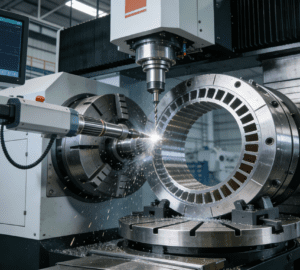
With the rapid development of science and technology, traditional machining methods are gradually unable to meet increasingly complex production demands, while CNC 4-axis machining stands out with its outstanding advantages. It is not only a machining technology, but also a powerful driving force for the continuous advancement of various industries. So, what are the remarkable advantages of CNC 4-axis machining?
The advantages of CNC 4-axis machining are mainly reflected in the following five aspects:
High-Precision Machining
CNC 4-axis machining can achieve extremely high machining precision. In traditional 3-axis machining, due to the limitations of workpiece shape and machining requirements, multiple clamping and adjustment operations may be required, which are prone to introducing errors. By adding one rotary axis, 4-axis machining can complete more machining processes in a single clamping, greatly reducing errors caused by repeated clamping. Meanwhile, advanced control systems and precision mechanical structures can ensure the motion accuracy of cutting tools during machining, resulting in machined parts with more accurate dimensions and higher surface quality.
Strong Machining Flexibility
The rotary axis of 4-axis machining endows the machining process with great flexibility. For parts with complex curved surfaces, inclined angles or helical structures, traditional 3-axis machining is often incompetent. Through the adjustment of the rotary axis, 4-axis machining allows cutting tools to access the workpiece from different angles, easily realizing the machining of these complex shapes. Whether it is high-precision parts in the fields of auto parts, aerospace components or medical devices, 4-axis machining can meet their diversified machining needs.
Improved Production Efficiency
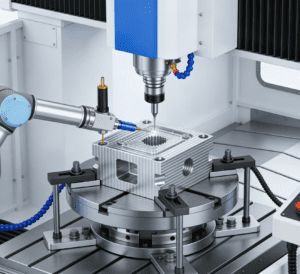
On the one hand, the characteristic of multi-process machining in a single clamping of 4-axis machining reduces auxiliary time in the machining process, avoids frequent clamping and adjustment, and thus greatly improves production efficiency. On the other hand, the multi-axis linkage machining method can realize high-speed cutting and accelerate machining speed. At the same time, advanced programming technology and automated control systems can optimize machining paths, further improving machining efficiency and reducing production costs. For batch machining of frame-type workpieces (such as automotive chassis frames or equipment brackets), many manufacturers are equipped with 4-Axis Robotic Frame Pick-up Systems—these systems can automatically identify, pick up and precisely place frame workpieces on the 4-axis machine tool table through multi-angle rotation and flexible arm movement, eliminating downtime caused by manual handling and positioning, and ensuring that the clamping accuracy is consistent with the machining precision of 4-axis equipment, thereby further amplifying the production efficiency advantage.
Expanded Machining Scope
CNC 4-axis machining can not only process conventional parts, but also expand into some special fields. For example, in the fields of art sculpture and ornament manufacturing, 4-axis machining can produce exquisite curved surface shapes and complex patterns, providing a new means for artistic creation. In the mold manufacturing industry, 4-axis machining can process more complex and precise molds, improving the quality and service life of molds, thereby providing better guarantee for product production.
Adaptability to Complex Machining Tasks
In some fields with extremely high requirements for machining precision and surface quality, such as aerospace and medical devices, CNC 4-axis machining can excellently complete complex machining tasks. For instance, the machining of aero-engine blades requires high-precision curved surface machining and strict dimensional control. Through precise programming and control, 4-axis machining can realize efficient machining of the complex shapes of blades, ensuring the performance and safety of the engine.
Robots realize the automated assembly of automotive connectors