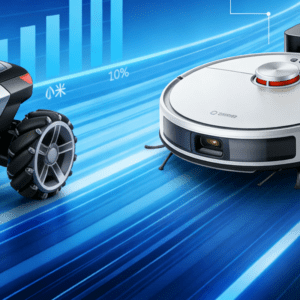
In the rapid iteration of the smart home track, the robot vacuum market is booming, and the era dominated by a single hardware has come to an end. The robot vacuum industry is undergoing a profound transformation focusing on technological intelligent upgrading, ecological layout strategies and global competition patterns. As the global robot vacuum market continues to expand, China’s intelligent manufacturing is emerging as a shining business card for the robot vacuum sector to go global.
According to the IDC Global Smart Home Device Market Quarterly Tracking Report, Q3 2025, the cumulative global shipments of robot vacuums reached 17.424 million units in the first three quarters of 2025, a year-on-year increase of 18.7%. Among them, Chinese brands – Roborock, Ecovacs, Dreame, Xiaomi and Narwal – claimed the top five spots in global shipments, accounting for nearly 70% of the total global market share. (Source: CCTV Finance)
In other words, seven out of every ten robot vacuums in the world are made in China, demonstrating the core competitiveness of Chinese enterprises in the global market.
Technological Upgrading: Scientific and Technological Innovation of China’s Robot Vacuums
Roborock ranks first in the global robot vacuum market with a 21.7% market share (3.788 million units shipped in the first three quarters of 2025, IDC data), a result of its multi-faceted efforts in technological R&D, global layout, localized operation and omni-channel expansion. Take Roborock’s G-Rover wheel-legged robot vacuum launched at CES 2026 as an example. Adopting a dual wheel-leg structure, it achieves an operational leap from 2D planar cleaning to 3D spatial cleaning. This robot vacuum redefines the boundaries of household cleaning scenarios and drives household service robots to evolve from “planar cleaning” to “3D whole-house coverage”.
Ecovacs has upgraded its core robot vacuum product line and extended its product reach to multiple fields. Deebot X12, Ecovacs’ floor cleaning product, is equipped with the new-generation OZMO ROLLER 3.0 constant-pressure live water mopping technology. Its key improvement is an all-new 26 cm roller, 50% longer than the previous generation. Through the comprehensive optimization of the roller structure, this technology has achieved a doubled improvement in cleaning efficiency.
Dual-Driven Growth by Sinking Domestic Market and Going Global
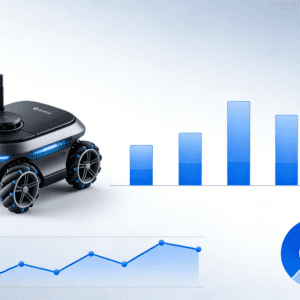
Relying on China’s strong supply chain advantages, the country’s robot vacuum industry is ushering in a dual growth period driven by the sinking of the domestic market and overseas expansion.
In the domestic market, boosted by national subsidies and driven by the improvement of material living standards and changes in consumption concepts, China’s robot vacuum market presents a blue ocean landscape. More and more families are accepting robot vacuums, and the household penetration rate of robot vacuums is rising steadily. In the overseas market, the market share of China-made robot vacuums is also increasing continuously. According to GfK data, from January to November 2025, the market share of Chinese robot vacuums in Western European countries reached 60%, while that in the Southeast Asian market surged from 38.8% in 2024 to 64.1%.
Conclusion
The robot vacuum industry is standing at the intersection of technology and market. From the continuous rise in global market share, to the independent and controllable core technologies, and then to the collaborative upgrading of the industrial chain, Chinese robot vacuum enterprises have achieved all-round improvement in competitiveness. In the future, Chinese robot vacuum enterprises will move towards a “technology source” and a “global market strategy”, continuing to demonstrate the global influence of China’s intelligent manufacturing.