
The start of 2026 has witnessed a booming development of China’s commercial aerospace sector on multiple fronts: CAS Space has entered the acceptance phase of its IPO counseling, emerging as the fastest-moving commercial aerospace enterprise in the IPO process following LandSpace; the recent successful launch of satellites by several banks including Shanghai Pudong Development Bank (SPDB Bank) and China Merchants Bank (CMB) has attracted wide attention from the industry. This marks that the aerospace sector, once centered on national strategies, has now integrated into diverse scenarios such as the livelihood economy.
A Landmark in Commercial Aerospace Application
The successful launch of satellites by multiple banks, a landmark implementation of commercial aerospace application scenarios, has garnered significant market attention.
On January 16, 2026, CMB’s “CMB Jinkui” satellite and SPDB Bank’s “SPDB Digital Intelligence” satellite were successfully launched and put into orbit off the coast of Rizhao, Shandong Province. This signifies that three joint-stock commercial banks have officially stepped into the era of “self-owned satellites”. It is learned that both satellites are part of the Tianqi Constellation, China’s first global low-orbit satellite Internet of Things (IoT) constellation, and the satellites launched by these banks this time will be mainly used to optimize their own risk control capabilities.
Innovations in Risk Control & Services
SPDB Bank stated that supported by the robust IoT data collection capacity of the Tianqi Constellation, it will further improve its intelligent risk control and comprehensive service system, enabling the rapid restoration and provision of critical basic financial services via satellite links in the event of major natural disasters and other extreme environments.
As early as 2024, CMB began its layout in the satellite banking field. On December 5, 2024, the “CMB-1” low-orbit broadband satellite was successfully put into orbit; the “CMB-2” broadband satellite was launched in March 2025. Together with the newly launched “CMB Jinkui”, the bank has launched a total of three satellites to date.
As CMB’s third commercial satellite, the “CMB Jinkui” focuses its core applications on three key areas: upgrading financial risk control, ensuring emergency communication support, and empowering industrial services. Satellite remote sensing technology has been deeply integrated into CMB’s financial system. Through its self-developed post-loan risk management system for retail credit real estate projects, the bank has greatly made up for the shortcomings of traditional manual inspections in terms of timeliness and coverage. In addition, satellite technology has also supported CMB Financial Leasing to launch China’s first SPV satellite leasing business, serving the financing needs of commercial aerospace enterprises through a “financing + physical asset” model and forming an innovative collaborative ecosystem of “aerospace + finance”.
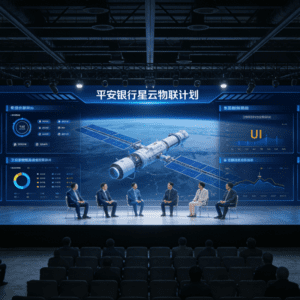
Notably, Ping An Bank is the first domestic bank to systematically deploy satellite services for the financial sector. Between 2020 and 2022, Ping An Bank launched three satellites (Ping An-1, Ping An-2 and Ping An-3) to support its “Nebula IoT Plan”, building a space-ground integrated data collection and risk control system to empower supply chain finance and inclusive finance.
Fueling Industry High-Quality Growth
The implementation of satellite applications in banking scenarios is a concrete microcosm of commercial aerospace integrating into the livelihood economy, which is underpinned by the dual support of policies and capital.
Since 2025, national-level institutional guarantees have been continuously put in place: the Commercial Aerospace Department has been officially established, forming a dedicated regulatory system; the Action Plan for Promoting the High-Quality and Safe Development of Commercial Aerospace (2025-2027) issued by the China National Space Administration has clarified the industrial development path; the refinement of the fifth set of listing standards on the Science and Technology Innovation Board has opened up capital exit channels for enterprises. Under such systematic support, the financing environment of the industry has improved significantly. Enterprises such as Galactic Energy and iSpace have successively completed financing rounds worth billions of yuan, and the National Manufacturing Transformation and Upgrading Fund has made a single investment of 900 million yuan in LandSpace, forming a diversified capital pattern featuring “guidance by state-owned players and participation of social capital”.