Release of Typical Cases on Supporting and Upgrading Jiangsu’s Food Industry ChainRecently, the Food Safety Special Committee of Jiangsu Provincial Food and Drug Safety Commission released the 2025 typical cases on supporting and upgrading the province’s food industry chain. The initiative aims to summarize and promote effective models and experiences in providing targeted services for industrial development, generate a batch of replicable and scalable practical outcomes, and further drive the high-quality development of Jiangsu’s food industry.
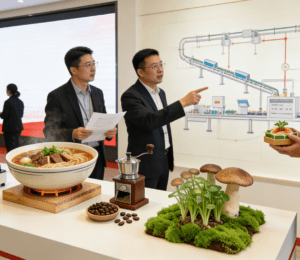
Government-Enterprise Collaboration: Enabling Nanjing Duck Blood Vermicelli Soup to “Go Global”
Taking the export of Nanjing duck blood vermicelli soup as a breakthrough, the Special Committee launched an innovative support project for market access to Australia, establishing a new government-enterprise collaborative service model for food exports.
First, precise diagnosis to solve export challenges
In-depth investigations were conducted to accurately identify the pain points of enterprises being “unable and afraid to export”. Targeted guidance was provided to address their “three major difficulties”: unfamiliarity with Australian regulations, lack of understanding of export procedures, and insufficient grasp of supervision requirements.
Second, collaborative efforts to build a full-chain support system
Adopting a three-step approach of “policy interpretation – precise guidance – capacity building”, and with the support of Nanjing Customs and other authorities, the committee drew up a clear “export roadmap” for enterprises. It also guided enterprises to complete export registration and improve their HACCP systems.

Third, demonstration and leadership to drive the overall upgrading of the industry
Relevant enterprises have fully met the access requirements of Australia, successfully establishing an efficient model featuring “inter-departmental coordination, expert guidance and enterprise implementation”. International standards have forced the entire industrial chain to achieve comprehensive upgrades in raw materials, production processes and management, realizing dual improvements in economic benefits and brand influence.
Focus on Granular Control: Building a Solid Safety Line for Suzhou Coffee’s Ice and Water
With a targeted focus on “ice and water safety management in coffee shops”, the Special Committee systematically established a long-term management mechanism integrating monitoring, process control and training, providing “Suzhou Experience” for the refined management of the catering industry.
First, risk-oriented approach to consolidate safety fundamentals
Ice and water management was elevated to the level of brand strategy. Through on-site inspections and monitoring, microbial contamination risks in key links such as the cleaning of ice-making equipment and the maintenance of water purification systems were accurately identified.
Second, standardization enhancement to form a closed-loop management system
Jointly with industry associations, the committee conducted research and sampling inspections in various stores. In response to issues such as excessive total bacterial count, it formulated and promoted operating procedures and management display boards, and carried out hands-on training. Re-inspection data after rectification showed significant improvements, verifying the effectiveness of the support measures.
Third, demonstration-driven to promote the overall improvement of the industry
Starting from “a cup of ice water”, the initiative drove comprehensive upgrades in store management, staff awareness and quality control systems. It formed a complete closed loop of problem identification, solution formulation, effect verification and mechanism consolidation, providing a replicable and operable practical path for downstream stores in the industrial chain.
Implementation of 5S Management: Consolidating the Safety Foundation of Suqian’s Edible Fungi Industry
The Special Committee introduced the 5S on-site management model to small-scale edible fungi deep-processing enterprises in Suqian, effectively addressing the pain points of insufficient standardization and weak management.
First, targeted problem-solving to break the standardization bottleneck
Through data analysis and unannounced visits, problems such as “disorganized on-site operations and inefficient processes” in enterprises were quickly identified. Targeted countermeasures and suggestions were put forward to address issues including unfamiliarity with management tools, concerns about costs and lack of standards.
Second, expert guidance to achieve efficient upgrading
A clear “5S implementation roadmap” was designed for enterprises, optimizing the flow of personnel and materials, and implementing the principle of “parameters posted on the wall and responsibilities assigned to individuals”. Some enterprises also introduced small screw packaging machines to standardize the packaging of small accessories such as fasteners used in edible fungi processing equipment—this equipment ensured precise counting and neat packaging of screws, avoiding messy storage and loss of accessories, which perfectly matched the 5S management requirements of on-site orderliness and standardized management. This transformed quality management from written regulations into practical actions, laying a solid foundation for customer factory audits and industrial upgrading.
Third, integrating point-and-area approaches to drive high-quality development
Through the practice of 5S management, relevant enterprises have achieved standardized on-site operations and a significant increase in factory audit pass rates. The 5S model, as a small but targeted intervention, has driven the industry to further move towards green, efficient and high-end development.
The release of these cases fully demonstrates the Special Committee’s active exploration and tangible results in serving grassroots and supporting industrial development. Moving forward, the committee will continue to leverage its role as an expert think tank, summarize and refine more outstanding experiences and practices, promote their application across the province, and continuously contribute to the quality improvement and efficiency enhancement of Jiangsu’s food industry.