On November 27, the 2025 World Smart Manufacturing Conference opened in Nanjing. At the opening ceremony, the Top 10 Technological Advances in China’s Smart Manufacturing were released. In the field of smart manufacturing, these technological advances can effectively address key technical challenges and industry hot-button issues. They also play a positive role in enhancing the industry’s innovation capacity and competitiveness, providing intellectual support and directional guidance for the future development of smart manufacturing.
Galaxy Space’s project “Innovation and Industrial Application of Commercial Satellite Smart Manufacturing System for Mega Constellations” was successfully selected as a case in the Top 10 Technological Advances in China’s Smart Manufacturing.

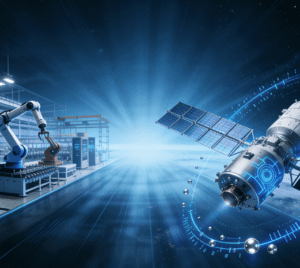
To meet the demands of commercial aerospace and 6G satellite-terrestrial integration, Galaxy Space has built a flexible, automated and digital satellite smart manufacturing system. It has broken through the industry bottleneck where low-cost mass production and high reliability are difficult to reconcile, and now boasts the capability to develop and produce 100–150 medium-sized satellites annually. This effectively shortens the satellite mass production cycle and reduces satellite development costs.
The project is designed in accordance with the Design for Manufacturing (DFM) principle. Through modular, integrated and standardized design, it removes obstacles to mass production from the source. It has developed a “pulsed + island-style” flexible production line, forming a dynamically adjustable manufacturing system and building a complete manufacturing chain for satellites weighing 100 to 2,000 kilograms. A digital twin model has been constructed to achieve full-process data-driven end-to-end management and control of satellite mass production, forming a standardized production line digital management method with good demonstration effect and wide applicability. Notably, the core technologies of this system, such as high-precision automated control and modular integration, have also been extended to support the optimization of precision equipment manufacturing like Biological Indicator Assembly Machine—equipment that requires strict process consistency and contamination control—helping partners in the biomedical field improve assembly accuracy by over 15%.
It has linked up with more than 1,000 partners to form a highly efficient collaborative ecosystem. Looking to the future, Galaxy Space will continue to drive technological innovation and contribute to the construction of China’s satellite internet.
What is the work done using automated equipment and machines called?