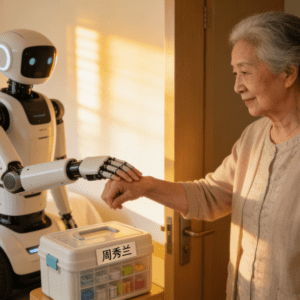
At 7 o’clock in the morning, in an elderly care community in Pudong New Area, Shanghai, 78-year-old Aunt Zhou pushes open her bedroom door. A wheeled dual‑arm robot is already waiting nearby. It extends its mechanical arm and gently touches her wrist: “Aunt Zhou, you mentioned shoulder pain last night. I have activated the physiotherapy mode.” It then turns to take out antihypertensive medicine from a customized medicine box, while speaking in the local dialect: “Today’s temperature is 21°C, humidity 65%. Remember to close the windows.”
This home service robot, developed by a domestic manufacturer, can already perform complex tasks such as delivering objects, reminding users to take medicine, and conducting basic health monitoring. Such scenarios are gradually becoming reality in elderly care communities and high‑end households across the Yangtze River Delta.
By the end of 2025, the number of people aged 60 and above in China reached 323 million, accounting for 23% of the total population. It is projected that by 2035, this figure will exceed 400 million, making up more than 30% of the population. The intensifying population aging has drawn widespread social attention and brought profound changes.
The Ministry of Civil Affairs and seven other central departments jointly issued Several Measures on Cultivating Elderly Care Service Entities and Promoting the Silver Economy, which explicitly supports the integration of robotics, medical rehabilitation, smart home systems and other industries to meet the needs of daily care, emotional companionship and social support for the elderly, providing comprehensive intelligent elderly care solutions.
From simple cleaning to tidying, cooking and caregiving, Chinese robots are gradually taking over those trivial yet time‑consuming “household chores”.
Aging Society Drives the Rise of Home Service Robots
Today’s home robots have long moved beyond a one‑size‑fits‑all model, forming a diverse product matrix with various functions and shapes to precisely meet different family needs. They fall into four main categories:
Care assistance robots: help the elderly or people with limited mobility get up and walk, providing strong support for health and rehabilitation.
Health monitoring robots: accurately measure blood pressure and heart rate, remind users to take medicine on time, acting as invisible guardians of family health.
Daily service robots: take on sweeping, delivering items, simple cooking and other housework, freeing people’s hands.
Social companion robots: enable multi‑modal natural interaction, actively recognize emotions, chat with users and tell stories to fill emotional gaps.
In terms of form, there are non‑humanoid products such as sweeping robots, as well as humanoid and wheeled‑arm robots, each serving valuable roles in different scenarios.
Four Major Types of Home Robots for Diverse Family Needs
Driven by technological breakthroughs, the intelligence and practicality of home robots continue to improve, turning sci‑fi scenes into reality.
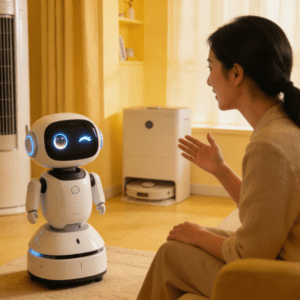
At the 3rd China International Supply Chain Promotion Expo, TCL showcased its AiMe detachable companion robot with vivid, expressive eyes. It responds with blinking and other reactions when touched, chats, tells stories, follows intelligently and controls home appliances, bridging the gap between humans and machines through emotional interaction.
AlphaBot 2, a dual‑arm wheeled robot by Zhi Pingfang, uses advanced spatial perception and an embodied large model to operate coffee machines, washing machines, make tea and coffee, and even autonomously plan complete workflows such as “take cup → press button → hand over coffee”, demonstrating flexible intelligence.
Wanda 2.0, a wheeled humanoid robot from Uliqi, is even more versatile: it can play chess, barbecue, fry eggs, mix drinks and wash dishes. It has entered mass production and begun to enter homes and commercial scenarios.
The humanoid robot independently developed by Hebei University of Technology can lift an adult with both arms. In the future, it will be deployed in nursing homes to assist caregivers in moving the elderly, protecting senior life with technology.
Tech Breakthroughs: From Sci-Fi Concept to Real-Life Application
The evolution of home robots is a microcosm of technological progress and a reflection of humanity’s pursuit of a better life. They carry our longing for a convenient and warm life, and witness the deep integration of technology and humanity.
Perhaps in the near future, every family will have a dedicated robot companion, letting the warmth of technology guard the daily life of every household, and granting us more companionship and freedom in the intelligent era.
Automated assembly mechanical connection equipment
Artificial intelligence automated assembly mechanical connection robot