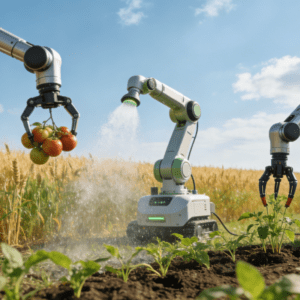
During this year’s Two Sessions, Minister of Agriculture and Rural Affairs Han Jun presented an inspiring set of data: China’s agricultural science and technology progress contribution rate has exceeded 64%, and the comprehensive mechanization rate of crop cultivation, planting, and harvesting has reached 76.7%. Even more encouraging is that a variety of intelligent equipment is demonstrating its prowess in agricultural production. Among them, intelligent harvesting robots, smart irrigation robots, and AI laser weeding robots have begun to move from laboratories to farmland, injecting strong technological impetus into agricultural modernization. These scenes, once only seen in science fiction movies, are gradually becoming a reality, profoundly transforming farming methods that have endured for thousands of years.
Smart Irrigation Robots: Maximizing the Value of Every Drop of Water
Water is the lifeblood of agriculture, yet traditional irrigation methods are often plagued by issues such as flood irrigation and low efficiency. The emergence of smart irrigation robots is completely changing this situation.
These robots are typically equipped with multiple sensors and the BeiDou Navigation Satellite System, enabling them to move autonomously in the fields and collect real-time data on soil moisture, temperature, and crop growth. Through analysis by built-in AI models, they can accurately determine which plots need watering and how much water to apply, and automatically adjust irrigation volume and fertilization ratios according to the needs of crops at different growth stages. Compared with traditional irrigation, smart irrigation robots can save 30%-50% of water, increase fertilizer utilization by more than 20%, and significantly reduce labor costs.
What’s more advanced is that these robots can also connect to meteorological data networks and automatically adjust irrigation plans based on weather forecasts. Before droughts or heavy rains, the system can respond in advance, avoiding water waste and preventing crop damage from too much or too little water. This precise irrigation model that “observes the sky, the land, and the crops” is leading agriculture from extensive management to precise regulation.
AI Laser Weeding Robots: Green Guardians of the Fields
Weeds compete with crops for nutrients, water, and sunlight, a major factor affecting yields. Traditional weeding methods either rely on manual labor, which is inefficient and costly, or use chemical herbicides, whose long-term use leads to increased weed resistance, soil degradation, and environmental pollution. The advent of AI laser weeding robots provides a brand-new solution to this dilemma.
These robots use computer vision and deep learning algorithms to quickly and accurately distinguish between crops and weeds in complex field environments. Once a weed is identified, it emits a high-energy laser beam that precisely targets the weed’s growth point, destroying its cell structure through instantaneous high temperatures to achieve physical eradication. The entire process requires no chemical agents, causes no harm to the soil or surrounding crops, and is truly green and environmentally friendly.
The advantages of AI laser weeding robots lie not only in environmental protection but also in efficiency. They can operate 24/7 under any weather conditions, with a recognition accuracy rate of over 99%, and a wide coverage per operation, greatly reducing farmers’ weeding burden. As technology matures, these robots are moving from experimental stages to practical applications, particularly suitable for organic agriculture and high-quality vegetable cultivation, providing a strong guarantee for producing green, pollution-free agricultural products.
Intelligent Harvesting Robots: Solving the Era’s Dilemma of “Who Will Harvest”
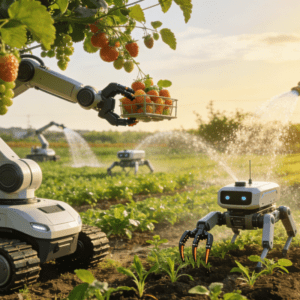
Harvesting is one of the most time- and labor-intensive links in agricultural production. With the aging rural labor force and population outflow, labor shortages and high labor costs have become prominent issues restricting the development of the fruit and vegetable industry. The research and application of intelligent harvesting robots are precisely aimed at solving this problem.
Modern harvesting robots integrate cutting-edge technologies such as machine vision, multi-sensor fusion, and flexible robotic arms. They can identify fruit color, size, and ripeness through 3D imaging systems, precisely locate harvesting positions, and then use robotic arms to pick fruits with appropriate force. The entire process is gentle and accurate, avoiding damage to fruits and plants. For different crop characteristics, researchers have designed various harvesting methods: some use suction cups, some use clamping and cutting, and some even simulate human hand movements for twisting and picking.
Currently, harvesting robots are widely used for tomatoes, strawberries, apples, citrus, and other crops. Compared with traditional manual harvesting, robots work tirelessly and continuously, with harvesting efficiency several times that of humans and stable harvesting quality. In facility agriculture such as greenhouses and three-dimensional cultivation, the advantages of these robots are even more pronounced. They can adapt to narrow spaces and complex environments, achieving all-weather precise operations.
From Standalone Operations to a Collaborative Future
Currently, intelligent harvesting, irrigation, and weeding robots perform their respective tasks, but they operate on similar technological logic: environmental perception, intelligent decision-making, and precise execution. With the development of the Internet of Things and cloud computing, these robots are gradually achieving interconnection. In future smart farms, irrigation robots can determine water replenishment plans based on soil moisture data, weeding robots can simultaneously patrol and eliminate weeds, and harvesting robots can automatically activate when fruits ripen—they share the same set of digital farm maps and follow the unified scheduling of a single cloud-based brain.
Even more promising is that the massive operational data accumulated by these intelligent devices is continuously feeding back and optimizing agricultural production models. Each precise irrigation, laser weeding, and non-destructive harvest makes AI algorithms smarter. As R&D costs decrease and application scales expand, smart agricultural machinery is transitioning from “unattainable” experimental products to “affordable and effective” practical equipment.
From “knowing how to farm” to “wisdom farming,” intelligent robots are redefining every link of agricultural production. They not only free people from heavy physical labor but also protect food security and the ecological environment through precise, efficient, and green operations. Looking ahead, with the deep integration of artificial intelligence and agriculture, these intelligent equipment shuttling through the fields will surely empower agricultural modernization to take flight, making the fields of hope thrive with even greater vitality.