
On March 3, 2026, six national authorities including the Ministry of Industry and Information Technology jointly issued the Guiding Opinions on Promoting the Comprehensive Utilization of Photovoltaic Modules. The release of this top-level design has instantly put the PV module recycling industry in the spotlight.
From its first mention in the Action Plan for Carbon Peaking Before 2030 in 2021, to being written into the Draft of the Ecological Environment Code in 2025, and then to the release of the Technical Specifications for Pollution Control in the Recycling and Treatment of Waste Photovoltaic Equipment by the Ministry of Ecology and Environment in February 2026, the policy system for PV module recycling has completed a leap from “occasional references” to “systematic construction” in just a few years.
Behind the favorable policy environment lies a huge market on the verge of explosive growth. Based on a 25-year design life of PV modules, the early-stage PV modules installed in China began to reach the end-of-life stage in 2025.
According to the China Photovoltaic Industry Association (CPIA), after 2030, the volume of decommissioned PV modules will peak at around 18 GW, or about 1.4 million tons. By 2040, the cumulative decommissioned volume will reach 253 GW, approximately 20 million tons.
The China PV Recycling and Circular Economy White Paper estimates that under the early decommissioning scenario, the cumulative market size of domestic PV recycling will reach 26 billion yuan by 2030 and surge to 420 billion yuan by 2050.
As the PV industry shifts from rapid expansion in the “manufacturing sector” to stock disposal in the “decommissioning sector”, module recycling is becoming a genuine gold-mining track in the “second half” of the industry.
Policy System Taking Shape: Full Implementation from Top-Level Design to Implementation Standards
1.1 Joint Document by Six Authorities Establishes the Overall Framework
The Guiding Opinions on Promoting the Comprehensive Utilization of Photovoltaic Modules, issued on February 13 and published on March 3, 2026, is the highest-level and most comprehensive guiding document in the PV recycling field to date.
It sets clear phased development goals:
By 2027, the cumulative comprehensive utilization of PV modules will reach 250,000 tons; breakthroughs will be made in key technologies such as surface structure dismantling, efficient separation of laminates, and component extraction; a group of leading enterprises in the comprehensive utilization of waste PV modules will be cultivated.
By 2030, a comprehensive utilization capacity for waste PV modules will be formed with close coordination between upstream and downstream industries, rational production capacity layout, and the ability to cope with large-scale decommissioning.
The Opinions systematically arrange tasks in seven areas: promoting green design and manufacturing in the PV industry, promoting orderly decommissioning of PV modules, promoting green and efficient dismantling and utilization, promoting coordinated development of the entire industrial chain, optimizing the environment for industrial innovation and development, and strengthening organizational guarantees, with an attachment on Key R&D Directions for Efficient Separation Processes.
This framework document not only defines the key directions for technological research but also clarifies the division of responsibilities among various departments, laying an institutional foundation for the standardized development of the industry.
1.2 Accelerated Improvement of Laws, Regulations and Standards
Before the release of the Opinions, policy preparations for PV recycling had been intensively rolled out. In April 2025, the Draft of the Ecological Environment Code of the People’s Republic of China was released for public comment. Article 977 clearly stipulates that “the state shall establish and improve a system for the disposal of decommissioned equipment by wind power and photovoltaic power generation enterprises”, establishing the legal status of the extended producer responsibility system at the code level.
In February 2026, the Ministry of Ecology and Environment issued the Technical Specifications for Pollution Control in the Recycling and Treatment of Waste Photovoltaic Equipment for the first time, putting forward pollution control requirements for the whole process of disassembly, collection, transportation, storage, dismantling, comprehensive utilization and disposal. It stipulates that the emission concentrations of volatile organic compounds, hydrogen sulfide, lead and its compounds in waste gas must meet national standards.
The introduction of this technical specification marks that PV recycling has moved from “no laws to abide by” to “standards to follow”.
Pan Helin, a renowned economist and member of the Information and Communication Economic Expert Committee of the Ministry of Industry and Information Technology, stated in an interview that China ranks first in the world in terms of PV installed capacity, and early modules have begun to enter the decommissioning period. Improper disposal will lead to waste of valuable resources and environmental pollution.
At present, PV recycling faces bottlenecks such as high costs, complex technologies and lack of industry standards, and policies are urgently needed to guide the market in solving these problems.
Market Size Measurement: A 10-Billion-Yuan Blue Ocean Accelerates to Open
2.1 Decommissioning Timeline: Large-Scale Decommissioning Begins in 2025
Since China’s new PV installed capacity exceeded the GW level for the first time to 2.2 GW in 2011, PV installations have continued to rise. Based on a 25-year design life, these early modules entered the decommissioning window around 2025.
A PV industry insider told 21st Century Business Herald: “In 2025, China has entered the stage of large-scale decommissioning of PV modules.”
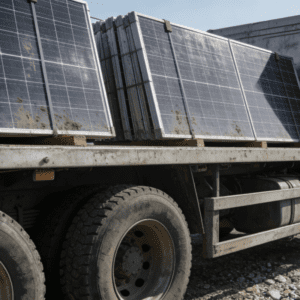
Notably, the actual decommissioning scale may far exceed the theoretical value. According to a research report by Cinda Securities, considering factors such as module quality and failure, design, construction and operation quality of PV power stations, and technical renovation and replacement, many domestic modules have been decommissioned ahead of the average life. This “early decommissioning” phenomenon will accelerate market expansion.
2.2 Resource Value Assessment: Hundreds of Billions in “Urban Minerals” Await Exploitation
PV modules contain a large amount of recyclable valuable materials. According to Weber Consulting, glass, aluminum and semiconductor materials account for up to 92% of crystalline silicon PV modules, plus about 1% precious metals such as silver.
If fully recycled, by 2030, 1.45 million tons of carbon steel, 1.1 million tons of glass, 540,000 tons of plastic, 260,000 tons of aluminum, 170,000 tons of copper, 50,000 tons of silicon and 550 tons of silver can be obtained from waste PV modules, with a cumulative value of 7.7 billion yuan. By 2040, the total recyclable value will reach 110 billion yuan.
The 2024 China PV Recycling and Circular Utilization White Paper gives a more optimistic estimate: under the early decommissioning scenario, the cumulative market size of PV recycling will reach about 26 billion yuan by 2030 and about 420 billion yuan by 2050.
2.3 Capacity Gap: Severe Shortage of Formal Channel Processing Capacity
Compared with the upcoming explosive market demand, there is a huge gap in formal recycling and processing capacity.
According to CPIA data, among the 1.2 million tons of decommissioned modules in China in 2025, fewer than 20 recycling enterprises have environmental protection qualifications nationwide, with an annual processing capacity of only 300,000 tons. The 900,000-ton gap all flows into illegal channels.
Cinda Securities judged: “The competition pattern is extremely fragmented, lacking large leading enterprises.”
“Small workshops compete for supply through low-price competition, disrupting market order, and at the same time causing serious environmental pollution due to lack of protection,” Cinda Securities warned in the research report. This “bad money drives out good” pattern is the core problem that the six-authority Opinions aims to solve.
Evolution of Technical Routes: From Laboratory to Industrialization
3.1 Three Main Technical Routes Coexist
At present, the mainstream technologies for PV recycling can be divided into three categories: physical method, chemical method and pyrolysis method.
Physical method: simple operation and low cost, mainly separating module materials through mechanical crushing and sorting. However, it has low metal recovery rate and insufficient material purity, making it difficult to achieve high-value component recovery.
Chemical method: high recovery rate, dissolving adhesive films and extracting valuable metals through acid-base solutions. But the process is complex and difficult to scale up, and the treatment of a large amount of acid-base waste liquid becomes an environmental problem.
Pyrolysis method: uses high temperature to decompose and gasify adhesive films to separate laminates. It has short reaction time and high recovery rate, becoming the main direction for large-scale treatment. However, it has high equipment investment threshold and high capital requirements for enterprises.
The Opinions clearly defines key R&D directions in the attachment Key R&D Directions for Efficient Separation Processes: accelerating research on the bonding mechanism of laminate films such as ethylene-vinyl acetate copolymer (EVA) and polyolefin elastomer (POE) with PV glass, cells, backsheets and other layers, focusing on theoretical research on the evolution of aged film structure and molecular adhesion of film particles.
3.2 Key Technological Breakthroughs: From Dismantling to High-Value Utilization
The Opinions puts forward systematic requirements for technological R&D, covering the entire chain from dismantling to high-value utilization:
Refined dismantling: encourage the application of automatic cleaning, punching and splitting equipment; develop adaptive dismantling systems that intelligently identify multi-size and multi-type PV modules; develop mobile and modular quick-disassembly technology and equipment; promote the “disassembly upon arrival” model.
Efficient separation: tackle green and efficient separation technologies for PV module components and adhesive films; encourage non-destructive dismantling technologies; explore ways to obtain intact glass and other materials.
High-value purification: encourage the extraction of silver from the metal grid lines of crystalline silicon cells; explore non-acidic or weakly acidic solvents for silver leaching; research reagent recycling technology in acid silver extraction; research and reserve fine purification processes for low-silver modules; extract copper, lead, tin and other metals from ribbons and busbars; classify and utilize silicon elements.
3.3 Industrial Breakthrough: The World’s First Fully Recycled PV Module
In September 2024, Trina Solar, a PV enterprise, announced the birth of the world’s first fully recycled PV module at its facility.
The company extracted silicon and silver from waste cells by dismantling waste PV modules to re-produce N-type monocrystalline silicon wafers and TOPCon cells, and used recycled aluminum and glass to re-produce aluminum frames and glass panels for encapsulation.
Tests showed that the TOPCon 210N-66 recycled PV module has a conversion efficiency of 20.7% and a power exceeding 645W. It has been put into use in the PV-storage-charging-discharging integrated microgrid demonstration station project at Trina Solar’s headquarters park.
This breakthrough proves that PV module recycling can not only realize material recycling but also achieve closed-loop regeneration “from module to module”, providing a feasible path for the high-value development of the industry.
Restructuring of Industrial Ecology: Innovation of Responsibility Mechanism and Business Model
4.1 Implementation of Extended Producer Responsibility System
The Opinions systematically constructs the responsibility chain for PV module recycling: guiding PV module manufacturers, PV power stations, construction parties and other owners to sell waste products generated in production, defective products with quality problems in use, damaged products caused by transportation and construction, and decommissioned modules with low photoelectric conversion efficiency or expired service life to comprehensive utilization enterprises.
Manufacturers, power stations and construction parties that entrust others to transport, utilize and dispose of waste PV modules shall verify the qualification and technical capacity of the entrusted party and agree on pollution prevention requirements. This regulation will force producers to carefully select recycling channels and accelerate the elimination of “bad money”.
4.2 Capacity Layout and Regional Coordination
The Opinions puts forward the principle of “rational layout”: combining the geographical distribution, scale, construction years and module characteristics of PV manufacturers and power stations, forecasting the scale of scrapping and decommissioning, and rationally constructing comprehensive utilization capacity.
Focusing on PV power station clusters in Northwest, East and North China, promote the large-scale development of PV module comprehensive utilization industry, encourage on-site comprehensive utilization to reduce transportation costs.
This layout is in line with the actual distribution of PV power stations in China: concentrated PV power stations are dense in the Northwest, distributed PV is developed in the East, and both are present in the North. Nearby capacity layout will greatly reduce transportation costs of decommissioned modules and improve recycling economy.
4.3 Business Model Innovation: Integration of the Whole Industrial Chain
The Opinions encourages PV module manufacturers, PV power stations and comprehensive utilization enterprises to actively extend the industrial chain, integrate processes such as surface structure dismantling, laminate separation and component extraction, promote intensive and integrated production, and help large-scale industrial development.
Pan Helin analyzed that this orientation will have a profound impact on various entities:
For PV module manufacturers, it will help achieve industrial upgrading and take the initiative to seize opportunities in PV recycling and reuse.
PV power stations will carry out a new round of investment and construction, eliminating old products and improving conversion efficiency with more efficient new products.
Comprehensive utilization enterprises can expand scale from recycling business and build core advantages through technological exploration.
Opportunities and Challenges: Key Issues for Gold-Mining in the “Second Half”
5.1 Market Opportunities: Superposition of Policy Dividends and Resource Value
The PV module recycling industry currently faces three overlapping opportunities:
Policy dividend period: from the six-authority Opinions to the technical specifications of the Ministry of Ecology and Environment, policy support is unprecedented. The Opinions clearly supports comprehensive utilization enterprises to apply for manufacturing single champions, specialized and sophisticated SMEs and high-tech enterprises; give play to the national industry-finance cooperation platform to guide financial institutions to provide credit financing support; expand diversified financing channels such as equity and debt, and encourage social capital to participate actively.
Pre-explosion market: the decommissioning peak is coming around 2030, and enterprises laying out in advance are expected to seize the first-mover advantage. It is predicted that the cumulative market size will reach 26 billion yuan by 2030, and the cumulative recyclable value will reach 110 billion yuan by 2040.
Resource security strategy: materials such as silver and silicon in PV modules are partially dependent on imports. Recycling can effectively reduce external dependence, in line with national strategic security orientation.
5.2 Practical Challenges: Economics and Standardization to Be Solved
Despite broad prospects, the PV recycling industry still faces multiple challenges:
Economic bottleneck: current recycling costs are high, and recycling of some low-value components is even “not worth the cost”. The Opinions proposes to research low-cost extraction technologies for low-value components such as glass, adhesive films and backsheets to improve the comprehensive utilization level of all components, which is a targeted response to this problem.
Insufficient technological maturity: existing technical routes have their own advantages and disadvantages, and a unified mainstream technical scheme has not yet been formed. Tan Youru, a PV analyst at BloombergNEF, pointed out that the overall domestic module decommissioning scale is small, and recycling capacity is not well utilized.
Imperfect standard system: although policies are intensively issued, industry standards are still under development. The current proliferation of “small workshops” needs to be reversed by releasing standardized enterprise lists and strengthening supervision and law enforcement.
Cross-regional coordination difficulties: PV modules are scattered, and the construction of recycling network involves cross-regional coordination, requiring collaboration between the government, enterprises and industry associations.
Outlook: Towards a 100-Billion-Yuan Green Circular Industry
The release of the six-authority Opinions marks that China’s PV module recycling industry has entered a new stage of standardized development.
From the short-term goal of cumulative recycling of 250,000 tons by 2027 to the long-term plan of forming capacity to cope with large-scale decommissioning by 2030, the policy has drawn a clear roadmap and timetable for industrial development.
For enterprises, the gold-mining opportunity in the “second half” of PV is opening up:
Leading PV manufacturers can extend the industrial chain and layout the “manufacturing-recycling-regeneration” closed loop.
Professional recycling enterprises can focus on R&D and build core advantages in dismantling, separation and purification.
Financial institutions can innovate green financial products to inject capital into the industry.
Cross-border players can find entry points in equipment manufacturing and information platforms.
Of course, gold-mining in the “second half” requires a long-term vision. The industry is still in the cultivation stage, and it is difficult to achieve high returns in the short term. But as a PV industry insider said: “When the real decommissioning wave arrives around 2030, enterprises laying out now will have a first-mover advantage.”
From a “major manufacturing country” to a “circular power”, the green closed loop of the PV industry is accelerating to take shape.
When decommissioned modules are no longer “waste” but “urban minerals”, and recycling turns from a “cost item” into a “value source”, a 100-billion-yuan green circular industry will truly rise. This is the most imaginative gold-mining track in the “second half” of PV.