Approximately one-third of all food produced for human consumption is lost or wasted during transportation and storage, amounting to up to 1.3 billion tons. The primary cause of this massive waste is extreme temperature fluctuations during food transport and storage.
As temperature management has long been overlooked, cold chain logistics plays a vital role in the storage and transportation of temperature-sensitive products. Whether it is life-saving vaccines, fresh produce, or seafood, maintaining products at optimal temperatures is critical to preserving their integrity.
Internet of Things (IoT) sensors provide a digital solution for preserving and transporting temperature-sensitive goods, driving a revolutionary transformation in cold chain management.
What is Cold Chain Management?
The global cold chain monitoring market is projected to grow strongly, reaching $11.82 billion by 2028 with a compound annual growth rate (CAGR) of 16.4%. This is mainly driven by strong industry demand for reliable real-time temperature monitoring solutions.
Cold chain management refers to the transportation and storage of products under controlled temperature conditions, ensuring that items such as dairy, meat, vaccines, and fresh produce stay within specified upper and lower temperature ranges.
Common industries that rely on cold chain logistics include:
Pharmaceuticals (e.g., vaccine distribution)
Food & Beverage (e.g., frozen seafood, dairy products)
Agriculture (e.g., fruits, vegetables, flowers)
Uncontrolled temperatures can lead to product spoilage and potential regulatory violations.
Practical Applications of Intelligent Temperature Monitoring
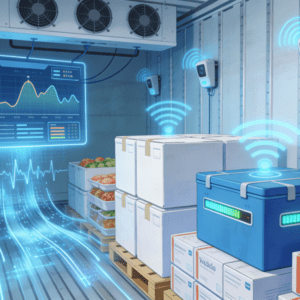
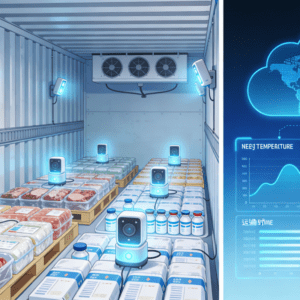
Intelligent sensors are embedded at every stage of the supply chain, such as in trucks, warehouses, or containers. They work together to collect environmental data, which is then transmitted via cellular or satellite networks to a cloud dashboard for real-time access. Here’s how it works:
The refrigerated container detects a temperature deviation
This triggers the IoT sensor to send an automatic alert to fleet managers
Fleet managers then take corrective actions to restore temperature, including rerouting and inspecting the container for malfunctions
Collected data is stored in data logs as evidence for regulatory audits and customer assurance
Some systems deploy artificial intelligence and machine learning to predict potential failures in advance, enabling predictive maintenance and improved reliability.
Key Benefits of IoT Cold Chain Monitoring
Reduced Food Spoilage
Real-time data enables early detection of issues before spoiled food enters the human food chain.
Согласие
Automated cold chain monitoring helps businesses comply with standards set by relevant health and food safety authorities.
Lower Operating Costs
Automated operations reduce reliance on manual labor, lowering the risk of product loss.
Enhanced Transparency
It provides verifiable data and visual indicators of cold chain performance, improving operational transparency.
Data-Driven Decisions
It helps businesses identify the most suitable routes, storage conditions, and logistics strategies for cold chain storage. IoT transforms physical assets into digital touchpoints, enabling a higher level of intelligence and control.
Intelligent Cold Chain: IoT Advantages
The Internet of Things (IoT) is a network of connected devices that collect and share information in real time. Unlike traditional passive manual monitoring systems, these advanced systems integrate multiple sensing functions and wireless connectivity to track factors such as temperature and humidity.
In cold chain logistics, IoT devices (e.g., wireless temperature sensors) are widely used. GPS trackers, RFID tags, and cloud data loggers enable unprecedented supply chain visibility and control.
Advantages of IoT-Enabled Cold Chain
Real-time monitoring: Helps track goods throughout the entire journey from farm to table.
Automatic alerts: The system immediately notifies users when temperatures exceed limits.
Compliance records: The system automatically logs cold storage data for audits and regulatory compliance.
Eliminates manual checks and minimizes errors: Technology-driven visibility reduces guesswork, allowing logistics providers to be proactive rather than reactive.
Industry Application Cases of IoT-Enabled Storage
Pharmaceutical Industry
The pharmaceutical industry has extremely strict temperature requirements; even minor deviations can render drugs ineffective or dangerous. Vaccine distribution relies on temperatures as low as -70°C. Integrated IoT technology ensures temperatures stay within thresholds while maintaining up-to-date logs for regulatory audits by the World Health Organization (WHO) or U.S. Food and Drug Administration (FDA).
Agriculture
The food and beverage industry benefits most from innovations in refrigeration technology. IoT devices enable continuous monitoring of the entire food supply chain from harvest to market, preserving freshness and preventing spoilage of fresh produce. This also applies to dairy and meat products, which are highly sensitive to temperature changes.
Warehousing & Customs
Leading temperature-controlled logistics providers deploy integrated sensor networks across all their refrigerated trailers for continuous monitoring. Smart refrigerated trailers are equipped with multi-zone temperature mapping systems, allowing products with different temperature requirements to be shipped simultaneously without compromising quality.
Cross-docking operations, where products are transferred multiple times between vehicles and facilities, present additional challenges. Warehousing companies such as Accurate Trailers near the Port of Miami integrate IoT-based temperature monitoring systems into cold storage areas, ensuring compliance with U.S. Customs regulations while maintaining ideal storage conditions for perishable imports.
Challenges of IoT Integration in Cold Storage
While the benefits of IoT are undeniable, it faces several challenges that may hinder its full potential.
Upfront Costs
The effectiveness of IoT depends on the installation of data infrastructure and sensors, which can be very expensive.
Poor Connectivity
Connectivity is a major issue in remote areas without stable cellular or satellite coverage, making long-haul routes difficult to manage.
Data Overload
Massive data streams must be filtered using analytical tools to generate actionable insights.
Security Risks
Due to the large volume of data involved, data breaches pose a major risk, potentially leaking critical information—especially in the pharmaceutical and other sectors.
Conclusion
As a rapidly developing technology, IoT is no longer a luxury but a necessary component to meet the demands of modern cold chain logistics. By adopting intelligent temperature monitoring, businesses can reduce losses, improve compliance, and gain full visibility into every stage of the supply chain.
The intelligent cold chain is rapidly becoming the new standard across industries, driven by the transformative power of IoT to enhance drug safety and food preservation.
If your business handles temperature-sensitive cargo and needs an IoT-capable logistics partner, investing in intelligent cold chain technology will bring disruptive improvements.
Ready to revolutionize your cold chain operations? Discover how IoT monitoring reduces temperature-related losses for more compliant and efficient operations.
Automated assembly mechanical connection equipment
Artificial intelligence automated assembly mechanical connection robot