Conference Background & Core Perspective: Humanoid Robots Enter Structured Scenarios
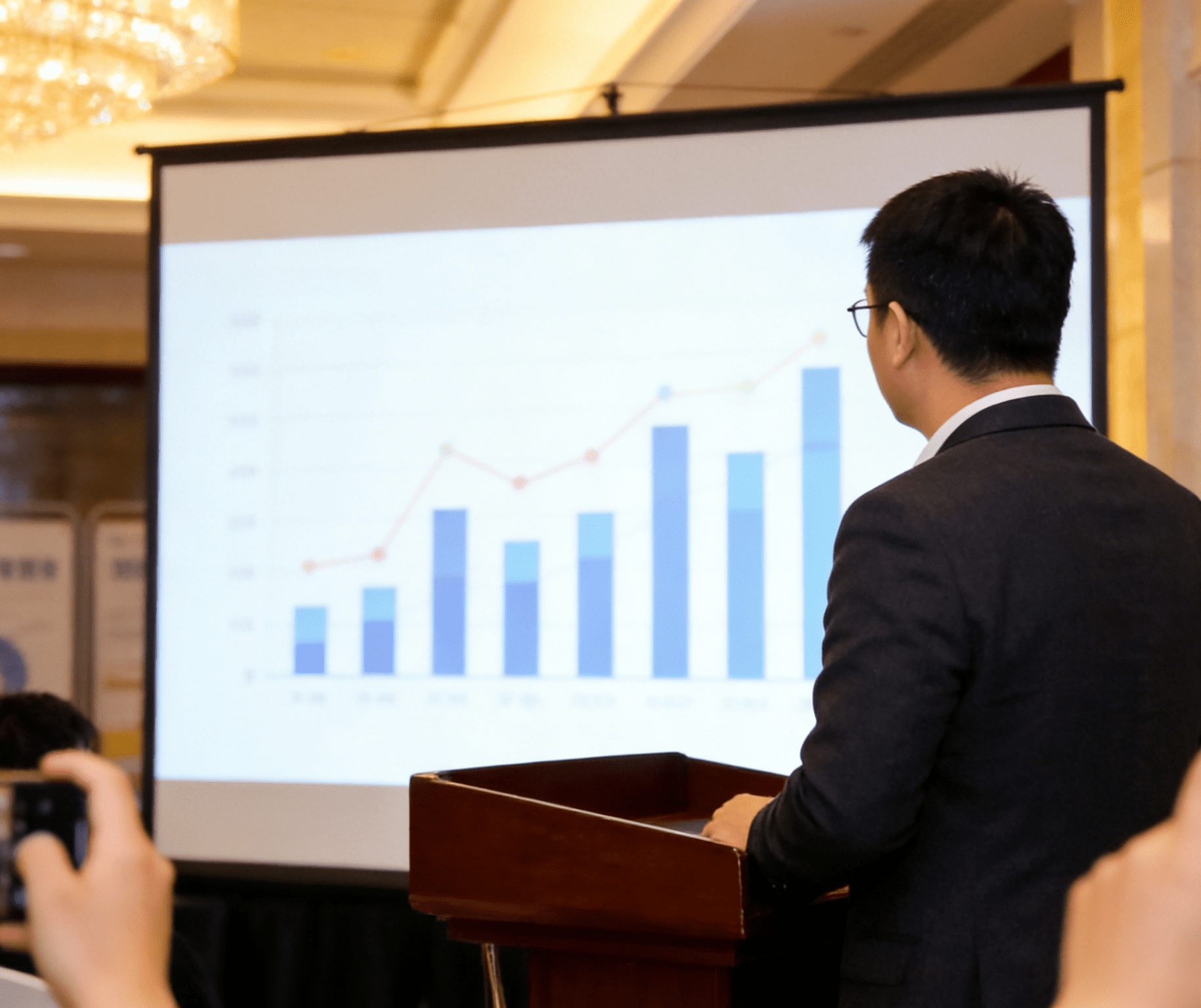
Guided by the People’s Government of Tongzhou District, Beijing, and hosted by Caijing Magazine, Caijing Online and Caijing Think Tank, the “Caijing Annual Conference 2026: Forecast and Strategy · Annual Dialogue and 2025 Global Wealth Management Forum” was held in Beijing from December 18 to 20, with the theme “China’s Steadfastness Amidst Changing Landscapes”.
On December 19, Zhou Jian, Founder, Chairman of the Board and Chief Executive Officer of UBTECH Robotics, stated in his speech that industrial humanoid robots are now capable of performing “hard labor” and taking on “grueling, repetitive tasks” in some factories. Currently, they are deployed in relatively structured scenarios, where they demonstrate better adaptability before the full realization of humanoid robots’ generalization capabilities and embodied intelligence technology, as well as the implementation of a universal world model for humanoid robots.
He pointed out that humanoid robots have now taken their first steps in relatively structured, single-task scenarios. However, there is still a long way to go before they can be applied in household and commercial settings. Nevertheless, as more real-world data is accumulated, it is believed that humanoid robots will be able to enter more scenarios involving simple and repetitive labor in the manufacturing industry in the future, gradually freeing humans from such work, and then gradually expanding into commercial and household scenarios.
Zhou Jian revealed that UBTECH is not only advancing the application of humanoid robots, but also accelerating their mass production. At present, the monthly production capacity of the latest-generation industrial humanoid robot Walker S2 exceeds 300 units. The production capacity will surpass 1,000 units in 2025, with an expected delivery of over 500 humanoid robots, mainly targeting key fields such as automobile manufacturing, intelligent manufacturing, smart logistics, and embodied intelligence data centers. It is projected that the annual production capacity of industrial humanoid robots will reach 10,000 units in 2026.
He opined that although humanoid robots may not be the only form, they will definitely become the carrier with the broadest and largest market potential in the future, capable of being deployed in the most diverse scenarios and even engaging in emotional communication with humans. These scenarios will gradually become a reality in the future. He also expressed his expectation that humanoid robots will truly enter manufacturing, commercial, and future household scenarios, replacing humans in more arduous and tedious labor.
Current Applications: Focus on Structured Factory Tasks
Excerpts from Zhou Jian’s Speech
December 19
It’s a great pleasure to attend this Global Wealth Management Forum. Thank you, Ms. Zhang Yandong, for the invitation. I just listened to Professor Zhang Zhengyou’s speech, and I was very pleased with his sharing. Before I start my formal remarks, I would like to share a few of my different perspectives.
The title of my speech today is “Embodied Intelligence Drives Industrial Transformation”. First, let’s talk about humanoid robots. At present, our industrial humanoid robots are already capable of doing “hard labor” and taking on “grueling, repetitive tasks” in some factories. They are currently deployed in relatively structured scenarios, where they have better adaptability before the full realization of humanoid robots’ generalization capabilities and embodied intelligence technology, as well as the implementation of a universal world model for humanoid robots.
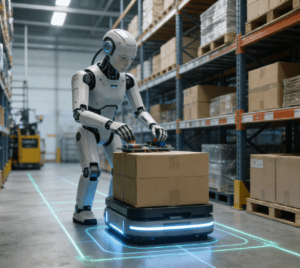
Let’s watch a video first. This video was filmed at Geely Zeekr’s factory. Many workstations in the factory, especially those for SPS (Set Parts Supply) material sorting, often have very narrow spaces. We once tried to use wheeled robots for these tasks, but later found that they interfered with each other during obstacle avoidance. In fact, as we can see, humanoid robots have excellent capabilities in climbing stairs and navigating complex terrains. Therefore, they are relatively capable of performing certain tasks in structured scenarios, such as manufacturing.
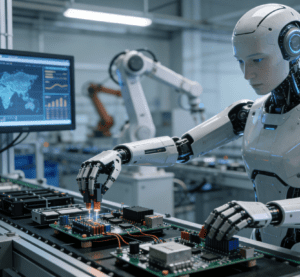
Currently, our industrial humanoid robots mainly focus on intelligent handling, intelligent sorting, intelligent quality inspection, and other tasks. For instance, in the precision manufacturing of medical supplies, they can cooperate with Mașină de asamblare a indicatorilor biologicis to complete high-precision feeding, assembly and seal inspection of biological indicators, effectively avoiding contamination and errors caused by manual operations. I visited an upstream auto parts factory last time. The workers responsible for loading and unloading materials there work extremely hard, performing a large amount of tasks every day. Humanoid robots have now taken their first steps in relatively structured, single-task scenarios. However, personally, I think there is still a long way to go before they can be applied in household and commercial settings.
Policy Support & Manufacturing Demand: The Value of Humanoid Robots
It is worth noting that the state has introduced a series of policies to support the adoption of humanoid robots in industrial manufacturing scenarios. The Guidelines for the Innovative Development of Humanoid Robots issued by the Ministry of Industry and Information Technology in 2023 proposed to promote the high-quality development of the humanoid robot industry, foster the formation of new productive forces, and empower the new type of industrialization at a high level. The proposals for the 15th Five-Year Plan mentioned promoting embodied intelligence to become a new economic growth point. Recently, the Ministry of Industry and Information Technology also stated that it will promote the adoption of industrial robots and humanoid robots in factories. Meanwhile, people have been asking a question: since we already have a large number of industrial robotic arms widely used in painting, spraying, and welding, why do we still need humanoid robots?
To answer this question, we need to delve into frontline manufacturing scenarios. This year, I have visited more than 70 factories and found that there are a large number of flexible manufacturing scenarios, including automotive assembly lines, where it is almost impossible to use industrial robotic arms or collaborative robotic arms, requiring a large number of workers. As we all know, some leading domestic enterprises have factories with hundreds of thousands of workers, many of whom perform extremely simple and tedious repetitive tasks every day. I talked to a forklift driver who said he has been driving forklifts for more than ten years, shuttling from Factory A to Factory B every day and doing nothing else. Sometimes, younger workers prefer to take on more flexible jobs. Such simple, tedious, and repetitive labor is an ideal scenario for introducing humanoid robots to provide assistance.
In addition, in the traditional industrial manufacturing process, besides the widely adopted welding robotic arms, spraying robotic arms, and logistics vehicles, some types of work, such as assembly and sorting, are still arduous, requiring workers to bend over frequently. Moreover, automobile factories have high-temperature racks, where workers have to endure extremely harsh working conditions. Our observations show that the optimal weight of boxes carried by workers every day should not exceed 15 kilograms, and 20 kilograms is the absolute limit, as heavier loads will impose excessive strain on their waists and bodies. Such scenarios are also ideal for introducing humanoid robots to help reduce the workload of workers.
Technological Accumulation: Full-Stack Tech & Autonomous Embodied Intelligence
Just now, Professor Zhang Zhengyou talked about embodied intelligence, which first requires perception of the external environment, followed by planning, reasoning, decision-making, and finally action execution. Since its establishment 13 years ago, UBTECH has been investing in full-stack technologies related to humanoid robots, including industry-leading robot hardware and control technologies (robot motion planning and control technologies, high-performance servo drives), artificial intelligence technologies (human-like “cerebrum” and “cerebellum”), robot-AI integration technologies (SLAM and autonomous navigation technologies, visual servoing operation and human-robot interaction), as well as the Robot Operating System Application Framework ROSA 2.0. We have also persisted in R&D investment in the crucial area of embodied intelligence “brain”. These technologies have endowed UBTECH’s humanoid robots with a smart “cerebrum” and an agile “cerebellum”, enabling them to truly achieve autonomous operation. We emphasize non-remote-controlled, non-pre-programmed, and autonomous embodied intelligence.
As you can see, the Tiangong Robot developed by the Beijing Humanoid Robot Innovation Center, a joint venture established by UBTECH, Xiaomi, Beijing Jingcheng Machinery & Electronics Holding Co., Ltd., and other entities, won the championship of this year’s Beijing Yizhuang Half Marathon and also claimed the title in the 100-meter sprint final at the Robot Games. All these achievements were accomplished through autonomous operation, without any remote control. Our goal is to defend the championship at next year’s marathon.
Dr. Xiong Youjun, CTO of UBTECH, serves as the CEO of the Beijing Humanoid Robot Innovation Center. Since the establishment of the center, UBTECH has licensed more than 300 patents to it. We are continuously making efforts to advance the Tiangong Robot. Meanwhile, based on our universal embodied intelligence platform “Huisikaiwu”, we are working towards the development of a future embodied intelligence “brain” and a world model. We believe that the future world model will possess predictive capabilities, going beyond the current simple functions of perception, reasoning, and action decision-making.
Mass Production Progress & Future Outlook: Toward Human-Machine Coexistence
In terms of application implementation, UBTECH is currently the humanoid robot company with the widest penetration in the global manufacturing industry. At present, leading global new energy brand BYD, as well as domestic and foreign automobile manufacturers such as Dongfeng Liuzhou Motor, FAW-Volkswagen Qingdao National-level Factory, Geely, Audi FAW NEV, and BAIC New Energy, along with leading enterprises in various fields including Foxconn and SF Express, have chosen to cooperate with UBTECH. The industrial humanoid robot Walker S series has been deployed in the largest number of factories worldwide for training in tasks such as handling, sorting, and quality inspection. As more real-world data is accumulated, it is believed that humanoid robots will be able to enter more scenarios involving simple and repetitive labor in the manufacturing industry in the future, gradually freeing humans from such work, and then gradually expanding into commercial and household scenarios.
We are not only advancing the application of humanoid robots, but also accelerating their mass production. At present, the monthly production capacity of our latest-generation industrial humanoid robot Walker S2 exceeds 300 units. The production capacity will surpass 1,000 units in 2025, with an expected delivery of over 500 humanoid robots, mainly targeting key fields such as automobile manufacturing, intelligent manufacturing, smart logistics, and embodied intelligence data centers. It is projected that the annual production capacity of industrial humanoid robots will reach 10,000 units in 2026.
This is our factory delivery video. As you can see in the video, the end effectors of humanoid robots include five-fingered dexterous hands, grippers, etc. We have always believed that in more than 70% of industrial scenarios, five-fingered dexterous hands are not necessarily required—three-fingered grippers are sufficient, and two-fingered grippers can also be used. Even suction cups can be adopted in some scenarios, such as logistics sorting. In some cases, robots can be equipped with a suction cup on the left hand and a three-fingered or five-fingered dexterous hand on the right hand. We leave the choice to customers, allowing them to select different end effectors according to their needs. Some overseas voices have claimed that our videos are fake, but they are definitely not. The videos were filmed on-site. We hope that in the future, such robots will continue to enter our customers’ premises, create value for them, truly replace arduous, simple, and repetitive labor in manufacturing factories, and showcase the real development level of China’s intelligent manufacturing.
In fact, mass production of humanoid robots is not an easy task. In 2025, we are very proud to have achieved a production capacity of 1,000 units for full-size, fully sensory, and autonomous humanoid robots. People may think that producing 10, 20, or even dozens of humanoid robots is relatively easy, but achieving a production scale of 1,000 units is extremely challenging. One of the biggest challenges is product consistency. From the first unit to the 500th and then to the 1,000th unit, any randomly selected robot must maintain a high level of consistency, which requires rigorous calibration, testing, and quality control processes to ensure that the final products can be put into practical use. Our robots have been tested on treadmills for hundreds of hours, and every single unit—whether it is the 250th or the 750th—demonstrates excellent performance consistency, including consistent precision requirements for each joint module.
I have always believed that the future of humanity lies in human-machine coexistence. This is a prediction chart of AI development made by American institutions, and many of the scenarios depicted in it have now become reality, including autonomous vehicles, medical surgical robots, and elderly care wheelchairs. I truly believe that although humanoid robots may not be the only form, they will definitely become the carrier with the broadest and largest market potential in the future, capable of being deployed in the most diverse scenarios and even engaging in emotional communication with humans. These scenarios will gradually become a reality in the future.
We look forward to our humanoid robots truly entering manufacturing, commercial, and future household scenarios, replacing humans in more arduous and tedious labor. We believe that humanoid robots will enter thousands of households. This morning, we announced a cooperation with Swan Daojia. We have joined hands with Swan Daojia’s team of one million domestic workers, who have an in-depth understanding of the actual needs of household work, such as cooking, vegetable washing, and cleaning. We hope to accumulate more data and scenarios in household settings in the future, and gradually enable humanoid robots to enter households and provide more services for humans.