Recently, data released by Lunar Technology in its 2025 Report on the Chinese Consumer-Grade Surveillance Camera Market shows that the total channel sales volume of the Chinese consumer-grade surveillance camera market reached 55.07 million units, a year-on-year increase of 3.0%. Among these, online sales accounted for 63.6%. The forecast indicates that the total channel sales volume of China’s consumer-grade surveillance cameras in 2026 will be approximately 54.36 million units, a slight year-on-year decrease of 1.3%. This marks the formal transition of the market from the previous high-speed penetration phase to a plateau adjustment phase. The slowdown in growth is not accidental but the result of the superposition of multiple structural changes. On the channel front, online sales have exceeded 60%, and emerging content e-commerce platforms are growing rapidly; in terms of brand structure, over a thousand manufacturers are competing head-to-head, with hundreds entering and exiting the market annually, leading to intense competition. However, the fundamental driving force comes from the profound evolution of product forms and user needs themselves. Traditional surveillance cameras with single functions are facing dual impacts from integrated smart hardware (such as smart door locks and doorbells) and active mobile terminals (such as home companion robots). A comprehensive “dimension-up competition” centered on home visual perception and interaction entry points has fully unfolded.
Integration-Based Replacement: Scenario Integration Delivers a Dimensional Attack on Single-Function Devices
The primary driver behind the market correction is the deep integration of product functions, with smart door locks and smart doorbells equipped with high-definition cameras being typical representatives of the rapid replacement of traditional door surveillance scenarios. The essence of this replacement is the efficiency and experience advantage of “one-stop solutions” over “single-function devices”.
From the user’s perspective, integrated products solve core pain points in real scenarios. In the past, to achieve secure remote door opening, video intercom, and door surveillance, users might need to purchase a smart lock, an electronic peephole, and a camera separately, facing numerous troubles such as complicated installation, multi-APP operation, and aesthetic disharmony. In contrast, an integrated smart doorbell or a smart lock with a camera seamlessly integrates security, control, and interaction functions, providing a concise and efficient complete solution through a single installation and a single application. This integration is not only reflected in hardware but also, more importantly, achieves a closed loop of data and linkage. For example, when the doorbell detects a stranger lingering at the door for a long time, it can automatically record video and push an alert to the user’s mobile phone. The user can directly communicate remotely via the APP or even issue a warning, realizing an upgrade in the security experience from “passive recording” to “active early warning and real-time intervention”.
This trend forces traditional surveillance camera manufacturers to rethink the value anchor of their products. As the basic front-door security scenario is occupied by more convenient integrated devices, cameras must deepen their development into other unmet and more complex scenarios or provide experiences far superior to those of standalone devices.
Mobile-Based Dimension-Up: Value Leap from Passive Observation to Active Interaction
If integrated replacement is a horizontal scenario integration, then mobile terminals represented by home companion robots launch a vertical value dimension-up attack in the core indoor surveillance scenario—care and companionship. This marks a paradigm shift in the market from “static security” to “dynamic interaction”.
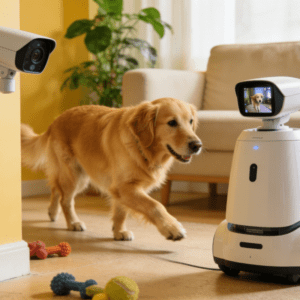
No matter how wide the field of view or how clear the image quality of fixed cameras is, their fundamental limitations lie in “passivity” and “staticity”. They can only observe images within a set range, cannot actively track targets, and their interaction is usually limited to one-way voice. In contrast, mobile robots equipped with cameras break the physical constraints of space. By using SLAM (Simultaneous Localization and Mapping) technology, they can navigate independently indoors and achieve continuous tracking and shooting of children or pets. Their built-in two-way voice and video call functions, as well as gradually developed emotional interaction algorithms, transform them from an observation tool into an interactive and responsive companion. For example, parents can interact with children remotely through the robot, and the robot can actively move to the elderly’s side and initiate an emergency call when detecting an accidental fall.
This value extension from “surveillance” to “companionship” greatly expands the meaning boundaries and target user groups of products. It no longer only serves the basic need of home safety but also delves into higher-level psychological needs such as emotional companionship, children’s education, and remote care. This poses a severe challenge to traditional camera enterprises but also points out the direction of high-end upgrades: either simulate mobile capabilities through ecological linkage (such as enabling cameras to collaborate with vacuum cleaners), or, in fixed forms, provide in-depth scene insight value that robots do not have through advanced AI algorithms (such as more accurate behavior recognition and emotional analysis).
The Nature of the Plateau Period: Growth Anxiety Under Stock Competition and Innovation Bottlenecks
The current plateau or slight decline of the market is an inevitable result of the common competition on the supply side and the phase saturation on the demand side.
On the supply side, fierce competition has led to severe product homogenization and price war. The products of many brands have highly overlapping functions, focusing generally on parametric improvements such as increasing resolution, expanding field of view, and adding pan-tilt rotation, while making limited breakthroughs in soft aspects that truly affect user experience, such as AI algorithm accuracy, data privacy protection, and cross-device linkage capabilities. This makes it difficult for the market to stimulate consumers’ desire to replace products, trapping the industry in low-level repetitive competition.
On the demand side, as the penetration rate of urban households approaches a high level, the incremental market dividend brought by first-time purchases is fading, and the main driving force of the market shifts to replacement upgrades and the excavation of niche scenarios. However, the current product innovation has not created a strong enough driving force for product replacement. Meanwhile, the demand of consumers themselves is stratifying and evolving: basic security monitoring has become a “standard”, and they are beginning to pursue more aesthetic forms, more seamless ecological integration, and intelligent services that can solve specific pain points (such as accurate pet abnormal behavior reports). There is a temporary mismatch and gap between the upgrading pace of supply and demand in the market, which is directly reflected in the lack of growth momentum.
Breakthrough Paths: Finding New Growth Curves in Differentiation and Integration
Faced with the dual squeeze of integration and mobility, the traditional surveillance camera market is not without a way out. The key lies in shifting from the mindset of “hardware parameter competition” to the strategy of “scenario value creation” and “ecosystem niche reshaping”.
Deepen Vertically: Focus on Professional Scenarios and Become a “Domain Expert”
When general functions are replaced, the way to survive is to become an “unreplaceable” expert in a specific niche scenario. For example, develop dedicated cameras for infant care scenarios with functions such as accurate cry recognition, sleep quality analysis, and temperature-humidity safety alerts; launch products for pet families that can identify pet breeds, analyze behavior patterns (such as abnormal scratching and frequent urination which may indicate health problems), and even automatically emit laser beams for interaction. By deeply binding to the specific needs of specific groups and providing integrated hardware and software solutions, a differentiated moat can be built.
Expand Horizontally: Embrace Ecosystem Integration and Transform into an “Intelligent Sensing Hub”
The future of smart homes is decentralized, with devices becoming nodes in the network. Surveillance camera enterprises should take the initiative to embrace this trend, no longer positioning themselves as independent “care devices” but as the “visual and sensing hub” of the smart home system. Actively adapt to universal protocols such as Matter to achieve deep linkage with lighting, security sensors, curtains, and home appliances. For example, when the camera detects the elderly getting up at night, it can automatically trigger the soft lighting of the corridor; when a stranger is detected, it can link with the smart lock to lock it and activate the whole-house alarm. By creating cross-device scenario-based experiences, the embedded value of the product in the ecosystem can be enhanced.
Reconstruct Experience: Strengthen Data Security and Build a Service Closed Loop
In an era of growing privacy anxiety, taking privacy protection as a core selling point may become an important breakthrough. Developing edge-side AI computing (where data is processed locally on the device without uploading), providing reliable home NAS (Network Attached Storage) local storage solutions, or cooperating with cloud service providers with authoritative security certifications can win the trust of high-end users. In addition, the business model can shift from a “one-time transaction” to a “hardware + service” sustainable revenue model. For example, provide paid cloud AI analysis services (such as weekly family security reports and pet behavior summaries), or combine with community security and insurance services to expand the value boundary.
Conclusion
The plateau period of the consumer-grade surveillance camera market is not the prelude to industry decline but the clarion call for a profound supply-side structural adjustment. The replacement by smart door locks/doorbells and the rise of home robots clearly reveal the direction of market evolution: from isolated “functional devices” to integrated “scenario solutions”; from cold “surveillance eyes” to warm “interactive companions”.
For market participants, the real challenge does not lie in the number of competitors but in whether they can re-understand the connotation of “surveillance” in the new era—it is far more than just recording and playback, but a comprehensive experience about safety, care, connection, and understanding. Only those enterprises that can break the shackles of hardware thinking, deepen the value in vertical scenarios, find their position in the open ecosystem, and manage data and privacy in a trustworthy way can stand out in this value reconstruction and lead the market into the next growth stage with higher quality and more imagination.