
Facing the new green and low-carbon development trend of the photovoltaic industry during the 15th Five-Year Plan period, forward-looking layout of the industrial ecosystem for photovoltaic module comprehensive utilization is a key measure to implement the Law of the People’s Republic of China on the Prevention and Control of Environmental Pollution by Solid Waste and the Action Plan for Green and Low-Carbon Development of the Manufacturing Sector (2025–2027).
The Recommendations of the Central Committee of the Communist Party of China on Formulating the 15th Five-Year Plan for National Economic and Social Development clearly puts forward the implementation of a comprehensive solid waste management campaign and in-depth promotion of the treatment of new pollutants, pointing out the direction for the comprehensive utilization of photovoltaic modules.
Recently, the Ministry of Industry and Information Technology, together with the Ministry of Ecology and Environment, the Ministry of Commerce, the State Administration for Market Regulation, the State Financial Regulatory Administration, and the National Energy Administration, jointly issued the Guiding Opinions on Promoting the Comprehensive Utilization of Photovoltaic Modules (hereinafter referred to as the “Guiding Opinions”). Based on the overall industrial development, the Opinions make systematic arrangements in accelerating the construction of the standard system, improving waste disposal management, strengthening process and technology research and development, and promoting downstream application of products. It guides the high-quality development of the photovoltaic module comprehensive utilization industry and opens up the “last mile” of the green closed-loop for the full life cycle of the photovoltaic industry.
Deeply Understanding the Fundamental and Leading Role of Standardization in Industrial Development
Standards are the technical support for economic activities and social development, a key component of the national basic system, and an important technical guarantee, institutional foundation and strategic resource for supporting and leading the construction of new industrialization.
Anchoring industrial development goals and building a closely connected standard system for photovoltaic module comprehensive utilization that runs through upstream and downstream links plays an important role in promoting industrial chain synergy and high-quality development, and provides strong support for the development goals specified in the Guiding Opinions.
(I) Leading the Direction of Technological Innovation and Comprehensively Improving Comprehensive Utilization Level
Technological innovation is the core driving force for high-quality industrial development, while standards provide a clear direction and implementation path for technological innovation.
Focusing on key technological breakthrough tasks proposed in the Guiding Opinions, such as surface structure disassembly, efficient separation of laminates, and extraction of valuable components, standards can set unified performance indicators, efficiency requirements and environmental bottom lines, guiding the industry to concentrate resources on tackling core areas and forming an innovation pattern with clear targets and coordinated progress.
Meanwhile, standards build an efficient bridge between technological R&D and industrial application, transforming advanced laboratory technologies into promotable and replicable industry norms, promoting the industrial application of advanced processes, technologies and equipment, and injecting sustained impetus into comprehensively improving the comprehensive utilization level of photovoltaic modules.
(II) Promoting Industrial Chain Synergy and Building an Efficient and Interactive Development Pattern
The Guiding Opinions clearly require promoting the coordinated development of the entire industrial chain of photovoltaic module comprehensive utilization.
As a unified technical language for the whole industry, standards can break collaboration barriers among all links and entities in photovoltaic module comprehensive utilization and realize efficient connection between upstream and downstream of the industrial chain.
In the production stage, standards clarify requirements for easy-disassembly design and specifications for recycled materials, guiding stable cooperation between photovoltaic module manufacturers and renewable resource comprehensive utilization enterprises.
In the retirement stage, unified scrapping judgment standards and standardized handover ensure that waste modules flow orderly to qualified comprehensive utilization enterprises and improve resource allocation efficiency.
In the comprehensive utilization stage, standardized disassembly processes, separation processes and purification requirements ensure the consistency and compatibility of product quality.
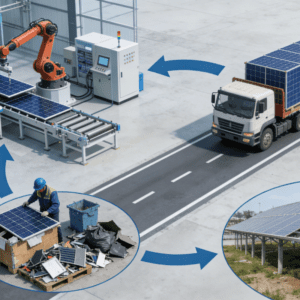
Through the link of standards, multi-party efforts are gathered to promote the formation of a coordinated development pattern of “green production – orderly retirement – efficient separation – high-value utilization”.
(III) Promoting the Construction of Industrial Ecology and Consolidating the Foundation for High-Quality Development
Standards are the core support for building a sound industrial ecosystem for photovoltaic module comprehensive utilization and provide a solid guarantee for large-scale and high-quality industrial development.
In terms of spatial layout, combined with the characteristics of photovoltaic power station clusters in Northwest, East, North China and other regions, standards guide the rational layout of comprehensive utilization capacity, encourage local utilization and reduce industrial operation costs.
In enterprise cultivation, by clarifying standards in technology, environmental protection, quality and other aspects, comprehensive utilization enterprises are guided to accurately position and upgrade quality, helping to cultivate a number of backbone enterprises and form a demonstration and leading effect.
In application expansion, standardized comprehensive utilization products can enhance market recognition and promote their expanded application in key fields such as metal smelting, equipment manufacturing and building materials production.
Led by standards, an industrial ecosystem with rational capacity layout, compliant and orderly enterprises, and diversified and integrated application scenarios will be built, providing strong support for the goals proposed in the Guiding Opinions – a cumulative comprehensive utilization volume of 250,000 tons by 2027 and the capacity to cope with the large-scale retirement wave by 2030.
Focusing on Core Links of the Whole Industrial Chain and Empowering Industrial Development with Precise Standards
The Guiding Opinions put forward a series of key tasks around the whole chain of photovoltaic module comprehensive utilization. Standardization needs precise docking and targeted efforts to translate policy requirements into technical specifications, empower the implementation of key tasks with standards, and promote high-quality industrial development.
(I) Leading Green Design with Standards and Strengthening Source Supply Efficiency
Greening at the source is the key to improving the comprehensive utilization level of photovoltaic modules. Strengthening green design of photovoltaic modules will effectively improve disassembly efficiency and reduce environmental risks in the treatment process.
The Guiding Opinions clearly propose to “promote green design and manufacturing in the photovoltaic industry, improve the easy-disassembly and easy-utilization level of modules and the proportion of recycled materials”, providing a clear direction for the green transformation of the industrial chain.
Standards should guide the green design of photovoltaic modules, clarify green selection requirements for raw and auxiliary materials, promote the application of recycled materials, facilitate the market circulation of green photovoltaic module products, reduce environmental costs of comprehensive utilization from the source, and realize two-way empowerment of green supply and efficient utilization.
(II) Regulating Retirement Procedures with Standards and Ensuring Orderly Circulation and Connection
Orderly retirement is the premise for photovoltaic module comprehensive utilization. Establishing scientific scrapping judgment standards for in-service modules is crucial to ensuring the safe operation of photovoltaic power stations and promoting orderly module retirement.
The Guiding Opinions clearly propose to “promote the orderly scrapping and retirement of photovoltaic modules and clarify module scrapping judgment standards”.
The formulation of photovoltaic module scrapping evaluation standards should be accelerated, the testing and scrapping evaluation procedures of in-service photovoltaic modules should be standardized, and the identification of faulty photovoltaic modules should be strengthened.
Meanwhile, standards should be formulated for the handover, transportation and entrusted disposal of waste photovoltaic modules, clarifying the requirements of all parties to ensure the compliant and orderly retirement of in-service photovoltaic modules.
(III) Supporting Technological Upgrading with Standards and Breaking Bottlenecks for Large-Scale Development
Low-loss disassembly of retired modules, efficient separation of laminates and high-efficiency purification of valuable components are the technical cores for large-scale industrial development.
The Guiding Opinions clearly require “improving the refinement level of disassembly, breaking through efficient separation processes, and promoting high-efficiency purification of valuable components”.
Standards should lead technological innovation in photovoltaic module comprehensive utilization, regulate technical requirements in disassembly, laminate separation, purification and other links, expand application fields of comprehensive utilization products, and improve the full-component comprehensive utilization level of photovoltaic modules.
(IV) Improving Management Efficiency with Standards and Consolidating the Bottom Line for Industrial Development
A sound industrial management system is the guarantee for sustainable industrial development.
The technical leading role of standards in industrial management and environmental protection should be fully exerted:In industrial management, strengthen the formulation of standards related to whole-process management, establish an enterprise information collection, interaction and supervision mechanism for each link, and establish and improve evaluation standards for comprehensive utilization enterprises to clarify industry access thresholds, promote standardized handover and comprehensive utilization of photovoltaic modules, and improve the overall management level and development quality of the industry.
In environmental protection, formulate standards for pollution control in the process of photovoltaic module comprehensive utilization, strictly control pollutant emissions in the comprehensive utilization process, and effectively reduce environmental risks.
III. Deepening Standard Development and Application to Build “Soft Power” for Industrial Development
In terms of standardization for photovoltaic module comprehensive utilization, relying on standardization technical organizations such as the National Technical Committee on Solar Photovoltaic Energy Systems (hereinafter referred to as the National PV Standardization Committee) and the Standardization Technical Committee of China Photovoltaic Industry Association, China has initially built a relatively complete organizational and standard system, carrying out more than 20 standard development tasks, which have effectively guided and promoted the standardized and professional development of the industry.
To implement the Guiding Opinions, the next step will continue to deepen the construction and application of the standard system, focusing on the following work:
(I) Improving the Standard System
Based on the industrial development needs of photovoltaic module comprehensive utilization, under the guidance of the Ministry of Industry and Information Technology and relying on the National PV Standardization Committee, implement the Guidelines for the Construction of the Photovoltaic Industry Standard System (2024 Edition), and continuously improve the standard system for photovoltaic module comprehensive utilization.
Focus on technical standards such as green design, scrapping, transportation, inspection and testing, comprehensive utilization, product carbon footprint of photovoltaic modules, as well as comprehensive utilization product standards. Accelerate standard layout in key links, consolidate the industrial foundation with standards, lead technological upgrading, regulate market order, and promote large-scale industrial development.
(II) Strengthening Standard Application and Implementation
Relying on industry associations and other relevant organizations, comprehensively strengthen standard promotion and interpretation through standard cloud classrooms, standard publicity meetings, special press releases and other forms, and strengthen the application in accordance with standards in all links of the industrial chain.
Simultaneously promote standard compliance evaluation and selection of typical application cases, promote advanced processes, technologies and products meeting standard requirements to take effect in actual scenarios, accelerate the formation of a virtuous cycle of “standard leadership – technological upgrading – industrial quality improvement”, and effectively transform standard advantages into practical effects of high-quality industrial development.
(III) Promoting Testing Capacity Building
Focus on the whole process of photovoltaic module comprehensive utilization and continuously improve the testing system.
Strengthen the R&D of testing technologies in key links such as photovoltaic module fault diagnosis, comprehensive utilization process level, valuable component purification capacity, and pollutant emission control, improve testing capacity and level, and effectively ensure the effective implementation of standards.
Strengthen the supporting role of standard-based testing in quality control, technological iteration and industry standardization, escort the orderly development of the industry with a standardized and professional testing system, and help build a high-quality and sustainable development pattern for the photovoltaic module comprehensive utilization industry.
(IV) Strengthening Alignment with International Standards
Relying on China’s scale advantage in global photovoltaic manufacturing and application, as well as practical experience in module comprehensive utilization, deeply participate in relevant work of international standardization organizations such as IEC.
Transform China’s technological achievements in photovoltaic module scrapping judgment, comprehensive utilization, high-value utilization of recycled materials and other fields into international standard proposals, and continuously enhance the international voice in photovoltaic standardization.
Combined with the global layout of China’s photovoltaic industry, promote the coordinated “going global” of domestic standards, testing and certification systems with Chinese technologies and equipment, and provide a credible Chinese solution for the green and high-quality development of the global photovoltaic industry.
Examples of Robot Automatic Assembly Lines
Advantages of Artificial Intelligence Automatic Assembly Lines