
Recently, Binjiang New Material Industrial Park in Xinbei District, Changzhou City, completed a key environmental infrastructure project. By systematically carrying out groundwater environmental surveys and building intelligent supervision capabilities, the park has achieved remarkable results in soil and groundwater remediation. Monitoring data shows that the compliance rate of national control points for groundwater in the park has reached 100%, and the improvement range of soil environmental quality has exceeded 84%, providing solid ecological support for the green transformation of chemical industrial parks along the Yangtze River.
Since the in-depth advancement of the Yangtze River Protection Strategy, Xinbei District has faced up to the historical legacy of “chemical plants encircling the Yangtze River”. Aiming to build the “Changzhou Model” for soil and groundwater risk management and control, it has gradually formed a systematic governance system featuring “precision investigation, intelligent early warning, institutional innovation, and social co-governance”.
Precision Source Tracing: Clarifying the Ecological Baseline
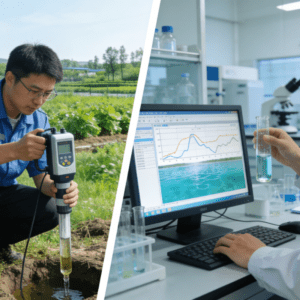
For the vacated land parcels of chemical enterprises within 1 kilometer along the Yangtze River, the local authorities implemented the “one plot, one plan” approach and simultaneously carried out soil and groundwater condition surveys. By constructing a three-level monitoring network covering “region—pollution source—sensitive target”, it tracks the migration of pollutants on a regular basis, clearly revealing the complete diffusion path from pollution sources, soil vadose zones, and groundwater aquifers to the Yangtze River water body, laying a scientific foundation for the precise zoning and hierarchical management of the park.
Digital Empowerment: Constructing an Intelligent Defense Line
The park innovatively introduced smart supervision and jointly built an intelligent management platform for soil and groundwater risk prediction and early warning with Jiangsu Environmental Protection Group. Integrating functions such as pollution migration simulation and risk visualization, the platform realizes dynamic early warning and rapid source tracing of environmental risks, forming a full-life-cycle management model covering “monitoring—assessment—early warning—control”. This practice has been included in the demonstration projects of the national key R&D program, becoming a digital benchmark for the governance of chemical industrial parks in the Yangtze River Delta region.
Diversified Co-governance: Pooling Environmental Protection Synergies
While advancing technical remediation, Xinbei District has actively built a pattern of social co-governance. With the Yangtze River Protection Exhibition Hall as the core of publicity and education, it widely disseminates environmental protection concepts through an “online + offline” matrix. It has carried out more than 150 person-times of special training, providing in-depth interpretation of policy and technical documents. In addition, the park has taken the lead in participating in the formulation of a number of local and group standards, promoting the transformation of governance experience into replicable and scalable institutional achievements.
Moving forward, Xinbei District will continue to deepen the construction of the soil and groundwater supervision system, effectively safeguard the ecological and environmental security of the park and the adjacent Yangtze River water body, promote the steady development of the chemical industry on the path of green development, and inject lasting green impetus into the high-quality development of the region.