
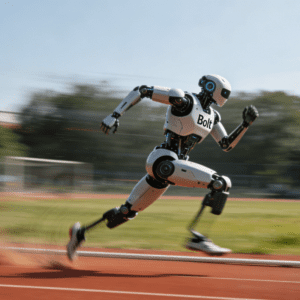
Bolt’s Groundbreaking Running Speed
On February 2, 2026, the Humanoid Robot Innovation Institute of the International Innovation Center of Zhejiang University officially unveiled the full-sized humanoid robot Bolt. It is reported that the robot has set a new global record for the fastest speed among humanoid robots with a running speed of 10 meters per second (approximately 36 kilometers per hour), making it the fastest humanoid robot in the world. This achievement not only demonstrates China’s leading strength in the field of dynamic motion and control of robots but also marks a significant breakthrough in the engineering and practical application of high-speed humanoid robot technology.
Technological Foundations & Core Challenges Behind the Breakthrough
In fact, this breakthrough is not accidental. As early as 2025, the research team of the institute had already set a global record for the fastest running speed with the quadruped robot “Black Panther”, accumulating profound technical foundations in the high-dynamic motion control of quadruped robots. From four legs to two legs, the challenges of motion control, such as center of gravity distribution, balance maintenance, and ground reaction force handling, become much more complex. Extending these technological accumulations to the field of humanoid robots once again showcases its continuous innovation capability in motion control and provides new possibilities for the future application of robots in scenarios such as emergency response and industrial operations.
Fast running is a systematic challenge for humanoid robots, which integrates perception, decision-making, control, and execution. The robot must complete the perception and judgment of the surrounding environment within milliseconds, dynamically adjust its step length, step frequency, and body posture, and maintain overall balance during continuous contact with the ground. This places extreme demands on the response speed of the hardware system, the explosive power of the drive unit, the real-time performance of the software algorithm, and the overall energy consumption management.
In August 2025, Xiong Youjun, General Manager of the Beijing Humanoid Robot Innovation Center, pointed out during the World Humanoid Robot Games that the key bottleneck in accelerating the running speed of robots lies in the reliability, stability, and heat control of the robot’s joints. He mentioned that from the perspective of motion control principles, the speed can be increased by adjusting the stride length and step frequency, but the increase in step frequency will significantly increase the burden on the joints, leading to a multiple increase in current, torque, and output power, thereby causing serious heat generation problems that affect the system’s continuous operation capability and lifespan.
The “Chinese speed” achieved by the humanoid robot Bolt is far more significant than the figure itself. It is a microcosm of China’s long-term investment and continuous innovation in the field of high-end robots, demonstrating the full-chain technological breakthrough capability from core algorithms, high-performance actuators to real-time perception and decision-making systems. At the same time, it also demonstrates China’s systematic innovation capability and engineering implementation speed in the R&D of high-performance robots to the world.
Two Core Engines Driving Industry Development
Looking ahead, the prospects for China’s humanoid robot industry are promising, and its development will be driven by two core engines:First, the accelerated popularization brought about by the rapid decline in production costs. As the core of the global robot supply chain, China has a significant cost advantage. In 2026, the production raw material costs for robots are expected to drop by 16%. Consulting firm Bain & Company expects that by 2035, the prices of global robot components will drop by approximately 70%. The continuous decline in costs will enable humanoid robots to move faster from mid-to-high-end laboratories and specific factories into broader commercial and service scenarios.
Second, the comprehensive penetration of application scenarios from industry to services. In the short term, industrial manufacturing remains the most definitive primary battlefield for humanoid robots. In fields such as automotive assembly, 3C electronics, and warehousing and logistics, robots will gradually take on repetitive, high-intensity, or hazardous tasks. In the medium to long term, with the further improvement of intelligence and dexterous operation capabilities, humanoid robots will play a greater role in smart elderly care, home services, commercial reception, and other fields, truly realizing the transformation from “being used in factories” to “being used at home”.
The Difference Between Machine Tools and Equipment
Welding Machine Tools and Equipment