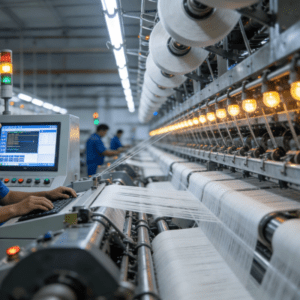
In 2025, facing a complex external environment with rapid changes and mounting difficulties and challenges, China’s textile industry adhered to the principle of seeking progress while maintaining stability, and steadily promoted industrial restructuring, transformation and upgrading.Supported by the improving and innovative macroeconomy and proactive macro policies, the industry achieved growth in output, domestic sales, investment and other operational indicators throughout the year. Although exports remained under pressure, they still showed structural resilience.
However, amid weak demand, intensified market competition and intertwined risks in the international trading environment, textile enterprises faced considerable difficulties in production and operation, and the foundation for steady recovery remained fragile.2026 marks the beginning of the 15th Five Year Plan period. The textile industry will still face many tests. It is necessary to further advance high-quality development, consolidate the foundation for stable performance, and achieve a sound and innovative start.
Production Grew Steadily but Slowed Down
In 2025, capacity utilization in the textile industry remained within a reasonable range, and overall production was stable. Affected by complex international conditions and weak end market demand, the growth rate of industrial output slowed down.
According to the National Bureau of Statistics:
Capacity utilization of textile industry and chemical fiber industry above designated size reached 77.5% and 85.8% respectively, both higher than the national industrial average of 74.4%.
The value added of industrial enterprises above designated size in the textile industry increased by 1.8% year on year, 2.6 percentage points lower than the previous year.
Sub sectors including chemical fiber, wool textile, linen textile, filament weaving, and technical textiles outperformed the industry average.
Among the 15 major categories of textile products counted by the National Bureau of Statistics, 8 categories including chemical fiber, fabric, and printed and dyed fabric achieved year on year output growth.
Domestic Sales Maintained Moderate Growth
In 2025, China’s urban and rural household income grew steadily. Policies to boost consumption and improve people’s livelihood took effect, unleashing the potential for expansion, quality improvement and upgrading of clothing consumption. Domestic sales of textiles and apparel achieved moderate growth.
According to the National Bureau of Statistics:
Per capita clothing consumption expenditure increased by 2.2% year on year.
Total retail sales of clothing, shoes, hats, and textiles above designated size exceeded 1.5 trillion yuan, up 3.2% year on year.
Innovations in formats such as live streaming commerce and instant retail, together with product and design trends including Chinese national style, outdoor sports, and sustainable fashion, drove steady growth in online retail.Retail sales of wearing goods online rose 1.9% year on year.
Exports Under Pressure but Showed Resilience
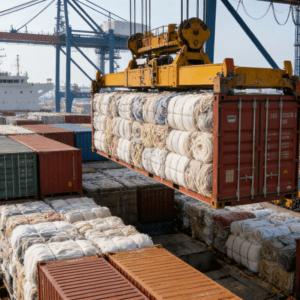
In 2025, facing a slowing global economy, rising unilateralism and protectionism, and frequent adjustments to U.S. tariff policies, China’s textile industry rose to challenges and responded proactively. It mitigated risks through supply innovation, market expansion and layout optimization.
According to China Customs:
Total exports of textiles and apparel reached $312.18 billion, down 2.5% year on year, but remained above $300 billion for the sixth consecutive year.
Intermediate products such as chemical fiber, yarn and fabric: exports up 1.8%.
Household and technical textiles: exports down 1.2% due to weaker U.S. demand.
Apparel: exports down 5.1%, under greater pressure from tariffs and weak demand.
Export markets became more diversified.Although exports to the U.S. and ASEAN declined, exports to more than 150 trading partners including the EU, UK, Japan and Canada achieved positive growth.
Investment Achieved Sound Growth
In 2025, guided by national policies, key textile enterprises accelerated high end, intelligent and green transformation. Fixed asset investment in the textile industry maintained sound growth on a high base.
According to the National Bureau of Statistics:
Fixed asset investment in textile industry, apparel industry and chemical fiber industry (excluding rural households) rose by 4.3%, 5.2% and 12.3% respectively, all outperforming the national manufacturing average.
Investment growth in the chemical fiber industry accelerated by 7.6 percentage points year on year.
A survey by China National Textile and Apparel Council showed that 53.7% of key enterprises focused on capacity upgrading, the highest level since the third quarter of 2023.
Operational Efficiency Came Under Growing Pressure
Affected by weak demand and export pressure, market competition intensified, and enterprises faced greater operational difficulties.
According to the National Bureau of Statistics:
Revenue of 39,000 textile enterprises above designated size decreased by 8.2% year on year.
Total profit decreased by 16.1%.
Profit margin stood at 3.5%, down 0.3 percentage points.
Revenue shrank across the entire industrial chain. Only the silk industry achieved profit growth.Total asset turnover and finished goods turnover fell by 9% and 7% respectively, while expense ratios rose by 0.3 percentage points, reflecting pressure from lower efficiency and higher inventories.
Striving for a Good Start to the 15th Five Year Plan
During the 14th Five Year Plan period, China’s textile industry withstood multiple external shocks, demonstrated the advantages of a complete manufacturing system, and accumulated strong internal momentum for high quality development.
In 2025, uncertainties and instabilities remain. The global economy is expected to slow, demand to remain weak, and international supply chains to adjust further.Nevertheless, China’s resilient macroeconomy and large, upgrading domestic market will provide fundamental support.
China’s GDP exceeded 140 trillion yuan for the first time.Growing consumer segments such as national trend, silver economy, sports, outdoor and health have great potential.Policies to expand domestic demand will further unlock scenario based consumption, integrated consumption and digital consumption, and encourage more investment in intelligent, green and integrated transformation.
The textile industry will thoroughly implement the spirit of the 20th National Congress of the Communist Party of China and the Central Economic Work Conference.Based on the positioning of “technology, fashion, green and health”, it will unswervingly advance high quality development, accelerate the construction of a modern industrial system, and make due contributions to the sound start of the 15th Five Year Plan for national economic and social development.