
At the end of 2025, Elon Musk, CEO of Tesla, posted on social media that the sun, as a “huge free nuclear fusion reactor in the sky”, is sufficient to meet the energy needs of the entire solar system. He also announced an ambitious plan: to deploy a 100GW solar AI satellite energy network annually to provide sustainable power for its space AI data centers and AI robots.
At the beginning of 2026, in a 3-hour interview, Musk mentioned the space photovoltaic plan again. He stated that solar energy is the only path to achieving human energy freedom and proposed a “three-step” strategy. First, use Tesla Megapack energy storage systems to store the idle electricity of power plants at night and improve power grid efficiency. Second, launch solar AI satellites into space to maximize solar energy utilization by leveraging the advantage of 24-hour sunlight in space. Third, build satellite factories on the moon.
Overseas Giants’ Layout: Sparking a New Round of Space Energy Competition
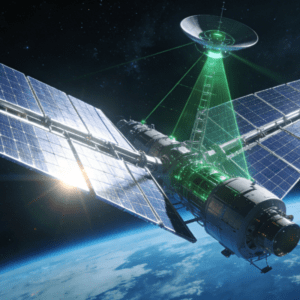
Space photovoltaics refers to installing photovoltaic modules on spacecraft or satellites to realize power supply. Against the backdrop of accelerated global satellite deployment and emerging demand for space computing power, it is regarded as “the core energy solution supporting the next-generation space infrastructure”.
In addition to SpaceX, Google recently announced its “Project Suncatcher” plan, which will build a space data center cluster composed of 81 AI satellites, with prototype satellites to be launched as early as 2027. Calculations by Starcloud show that for building a data center of the same scale, the 10-year core cost of the space solution (about 8.2 million US dollars) is only 5% of that of the ground solution (about 167 million US dollars). Starcloud also points out that the advantage of the space solution lies in utilizing the efficient solar energy in space and the natural vacuum radiation cooling environment, which can fundamentally solve the energy consumption, heat dissipation and land bottlenecks faced by ground AI computing power.
Trillion-Yuan Track with Broad Expansion Prospects
According to a research report by Guojin Securities, as a core branch of the commercial aerospace sector, space photovoltaics will be the strongest main line of the electric power and new energy sector in 2026. Great Wall Securities believes that after undergoing the experience of this round of low-Earth orbit deployment, the space photovoltaic industry chain will better support the subsequent expansion of space computing power, ushering in enormous opportunities for market expansion and pattern reshaping. It further points out that in the space environment, the two major restrictive factors of water vapor and oxygen are naturally resolved, making it the most suitable application field for perovskite batteries. CITIC Securities also emphasizes that a consensus has gradually formed on space computing power. As the only way to supply power to satellites, the proportion of photovoltaic system costs is expected to continue to rise, and the market scale is expected to reach the trillion-yuan level.
Accelerating the Landing of Space Photovoltaic Technology
Similarly, domestic photovoltaic giants have successively announced their entry into the space photovoltaic track.
At the start of the year, Li Xiande, Chairman of Jinko Solar, emphasized in his New Year speech that space photovoltaics is the only feasible long-term energy support for realizing space computing power, deep space exploration and other universal scenarios, and stated that Jinko Solar should explore the market opportunities of space photovoltaics. Gao Jifan, Chairman of Trina Solar, proposed in his New Year speech: “Trina will accelerate the mass production and commercialization process of perovskite and open a new era of space photovoltaic interstellar computing power.” Zheng Hongwei, Vice Chairman of Junda Co., Ltd., also stated at an investor event that the space photovoltaic market has huge potential. The low-Earth orbit satellite field alone is expected to form a trillion-yuan output value, and the market space for space computing power centers is even broader.
On January 12, Mingyang Smart Energy, a leading domestic wind turbine manufacturer, officially announced that it intends to acquire control of Dehua Chip by issuing shares and paying cash, and raise supporting funds, officially stepping into the commercial aerospace energy sector. According to an article from the Zhongshan Bureau of Industry and Information Technology, Dehua Chip has been deeply engaged in the aerospace vehicle power and energy field for more than 10 years, owning over 100 core patents (including 1 internationally authorized patent), and the photoelectric conversion efficiency of its gallium arsenide space solar cells reaches 32%. At present, the products developed by Dehua Chip have been successfully carried on the Tianzhou-6 cargo spacecraft and applied to foreign satellites such as the Pakistan Scientific Experiment Satellite. Therefore, the industry believes that Mingyang Smart Energy will officially cross over into the space photovoltaic field through this acquisition.
From the “trillion-yuan track” described in brokerage research reports to the official announcement of entry by giants at home and abroad, space photovoltaics is accelerating into reality, becoming the hottest conceptual trend in A-shares at the start of 2026, and is poised to be the “strongest theme” in the electric power and new energy sector following nuclear fusion and robots.