In the custom manufacturing of metal housings for automation equipment, bending and stamping have long been recognized as the industry’s preferred forming process. Yet many equipment manufacturers still face the same dilemma: even with the same bending and stamping process, some suppliers deliver housings with qualified precision, stable structure, and successful one‑time assembly, while others produce parts plagued by springback deformation, misaligned holes, excessive surface defects, and delayed delivery.
The answer is simple: unlocking the full potential of bending and stamping never relies on a single bending machine or press alone. It requires end‑to‑end professional support, from upfront design and process matching to full‑process control and scenario‑based adaptation. To maximize the value of bending and stamping and avoid common pitfalls in non‑standard customization, these core principles are essential.
The Foundation for Realizing Bending and Stamping Advantages
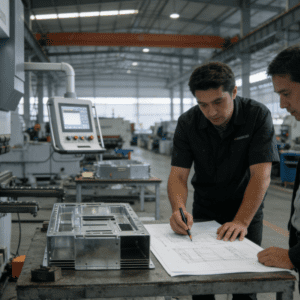
Many manufacturers encounter problems in housing customization due to flaws in the design phase: they only consider the housing’s function and appearance, without accounting for the technical characteristics of bending and stamping. As a result, when drawings are put into production, processing becomes extremely difficult and costly, design intent cannot be achieved, or structural deformation and substandard precision occur.
Experienced custom manufacturers always intervene early in the design phase to optimize drawings for process compliance, without altering the housing’s core functions or design requirements. This improves process feasibility, reduces costs, and boosts efficiency. The key optimization directions include three areas:
Bending Process Adaptation Optimization Different materials and sheet thicknesses have clear minimum bending radius requirements. An unreasonably small bending radius causes cracks and excessive spring back at the bend, directly impairing dimensional accuracy. Meanwhile, overly short bending flanges prevent precise bending. Early optimization avoids downstream processing issues.
Stamping Process Adaptation OptimizationA safe clearance must be reserved between punched holes and bending edges. If holes are too close to bends, stretching and deformation occur during bending, disrupting subsequent assembly. In addition, different sheet thicknesses correspond to minimum punching sizes. Avoiding unachievable small‑hole designs eliminates the need for additional laser processing and inflated custom costs.
Structural Integration Optimization Leveraging the integrated forming capability of bending and stamping, the housing structure is optimized by replacing multi‑sheet assembly with one‑piece bending. This reduces welding processes, enhances structural strength, lowers manufacturing costs, and shortens production cycles.
The Key to Stable Quality in Bending and Stamping
Bending and stamping are only the core forming processes. To obtain finished housings ready for direct assembly, additional processes such as welding, grinding, surface treatment, and inspection are required. A lack of quality control in any leads to substandard final products.
Many manufacturers only perform bending and stamping in‑house and outsource all subsequent processes. This not only extends lead times but also creates inconsistent quality standards and accountability disputes between processes, with the customer ultimately bearing all losses. Only manufacturers with full‑process closed‑loop capabilities can fully realize the advantages of bending and stamping.
Collaborative Control of Post‑Forming Processes Welding after bending and stamping must use compatible processes to avoid deformation caused by high temperatures, which would destroy established dimensional accuracy. Grinding must balance flatness and precision to prevent dimensional deviations from over‑grinding, ensuring forming accuracy is fully preserved.
Full‑Link Adaptation for Surface Treatment Surface treatment serves not only aesthetics but also improved corrosion and wear resistance. The appropriate surface treatment must be selected based on the housing’s application scenario, with process requirements considered as early as the bending and stamping phase. For example, rounded bend designs prevent paint buildup and exposure during spraying, while structural design avoids blind spots in electroplating, ensuring both appearance and protective performance meet standards.
Full‑Process Quality Control System Clear quality standards apply at every stage: raw material inspection for material and thickness, first‑article approval and in‑process checks for bending and stamping, and full dimensional, visual, and protective performance testing for finished products. This ensures every housing leaving the factory complies with drawings and operational requirements. A dedicated project manager tracks production in real time, enabling transparent progress monitoring and rapid issue resolution.
Precision Matching to Equipment Requirements
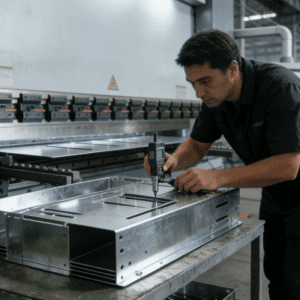
Different types of automation equipment have distinct core requirements for metal housings: precision testing instruments demand ultra‑high accuracy and stability; protective covers for large automated lines prioritize structural strength and batch consistency. To maximize the value of bending and stamping, a single set of process parameters cannot fit all applications. Differentiated process adaptation is required based on usage scenarios and core demands.
Metal Housings for Precision Testing / Measuring Instruments Core needs: micron‑level dimensional accuracy, minimal forming springback, excellent structural stability.Process focus: high‑precision CNC bending and stamping equipment, strict control of sheet material and internal stress, optimized bending parameters to reduce springback, and integrated punching and bending to ensure relative positional accuracy of mounting points, perfectly matching the assembly of precision optical components and sensors.
Housings for Industrial Control / Electrical Control Cabinets Core needs: high protection rating, electromagnetic shielding, consistent batch structure.Process focus: one‑piece bending to minimize welds and improve sealing for IP54/IP65 protection; optimized lap joints for enhanced electromagnetic shielding in complex workshop environments; standardized parameters to ensure consistency across batches for mass assembly.
Protective Covers for Automated Production Lines / Large EquipmentCore needs: structural strength, installation compatibility, rapid delivery.Process focus: segmented bending + precision positioning stamping to ensure splicing accuracy for large covers; optimized bend structures to improve impact and deformation resistance; digital flexible production to quickly adapt to custom covers of varying sizes and structures, supporting fast project delivery.
Housings for New Energy / Lithium Battery Automation EquipmentCore needs: high corrosion resistance, structural stability, cleanroom compatibility.Process focus: bending and stamping processes adapted for corrosion‑resistant materials such as stainless steel and galvanized steel; strict control of material integrity at bends to avoid cracks that reduce corrosion resistance; one‑piece forming to minimize welds and dust accumulation for lithium battery cleanrooms; paired high‑temperature and corrosion‑resistant surface treatments for special operating conditions.
Four Key Principles to Avoid Pitfalls in Bending and Stamping for Automation Equipment Housings
Do Not Focus Only on Equipment – Prioritize Industry Process ExperienceAutomation equipment housings are highly non‑standard, with vastly different requirements across industries. Beyond pure equipment specifications, a manufacturer’s experience serving the automation sector, understanding of equipment needs, and proven process implementation capabilities are far more important. Experienced manufacturers anticipate and avoid design, processing, and assembly issues, greatly reducing risks.
Do Not Chase Low Single‑Process Prices – Focus on Full‑Process Total CostMany buyers compare only bending and stamping quotes while ignoring downstream costs, hidden transit expenses, and rework risks. Low single‑process prices often lead to upselling on later stages or reduced quality standards to preserve margins, resulting in total costs far exceeding expectations. Manufacturers with full‑process one‑stop services offer transparent pricing and more controllable overall costs.
Do Not Rely on Verbal Promises – Inspect Sample Detail ControlThe true capability of bending and stamping is reflected in sample details: uniform bend radii, burr‑free hole edges, full compliance of dimensional accuracy with drawings, and uniform, defect‑free surface treatment. These details directly reflect process capability and quality standards. Always confirm samples and verify quality before mass production.
Do Not Focus Only on Mass Production Capacity – Prioritize Flexible Service CapabilityThe automation industry features volatile demand, ranging from single prototypes and small‑batch trials to mass production. When selecting a supplier, evaluate not only large‑scale production capacity but also flexibility: the ability to quickly respond to small‑batch custom orders, adjust schedules for urgent requests, and support design revisions and process optimization during R&D, fully aligning with the equipment’s development and production rhythm.
Custom manufacturing of metal housings for automation equipment is never simply “manufacturing to drawings.” It is a full‑process professional service built around the core processes of bending and stamping. Only through process adaptation from the design stage, stable quality via closed‑loop full‑process control, and differentiated process optimization tailored to equipment scenarios can the core advantages of bending and stamping be fully realized – delivering housings with qualified precision, stable quality, controllable costs, and efficient delivery.