In an era of rapid technological advancement, Brain-Computer Interface (BCI) technology is transforming our lives and cognition at an unprecedented pace. Once confined to science fiction, this technology has now become a reality, bringing unprecedented opportunities and challenges to humanity. From helping paralyzed patients stand and walk again to enabling mind control of smart homes, the application scenarios of BCI are constantly expanding, and its development prospects are highly anticipated. However, behind these technological breakthroughs, BCI also faces numerous challenges, such as signal acquisition accuracy, biocompatibility, and ethical issues, all of which require careful consideration and resolution.
BCI as a Key Future Industry
According to Jiefang Daily’s news website, the fourth session of the 16th Shanghai Municipal People’s Congress opened on the morning of February 3 at the World Expo Center. Shanghai Mayor Gong Zheng delivered the Government Work Report.
The report stated that this year, the city will deepen the construction of an international economic center. Focusing on building a modern industrial system, it will continue to consolidate and strengthen the foundation of the real economy, carry out digital and intelligent technology, green technology transformation, and production line upgrades in industries such as petrochemicals and steel, accelerate the implementation of a number of major industrial projects in fields including integrated circuits, biomedicine, and artificial intelligence, actively support the development of industries such as intelligent connected new energy vehicles, marine economy, low-altitude economy, aerospace, and satellite internet, foster characteristic digital industrial clusters, and vigorously promote the expansion, quality improvement, and clustered development of the service sector.
The report indicated that this year, Shanghai will advance the construction of the Lingang Science and Technology Innovation City, accelerate the development of a number of high-level science and innovation communities, continuously enhance the capabilities of characteristic industrial parks such as the Oriental Chip Port and the Large Aircraft Park, and vigorously cultivate and develop future industries including brain-computer interface and fourth-generation semiconductors.
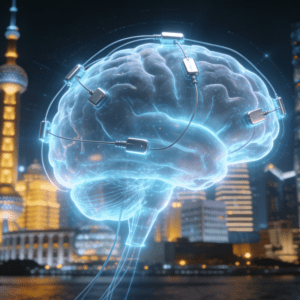
What is BCI? Core Principles and Main Technologies
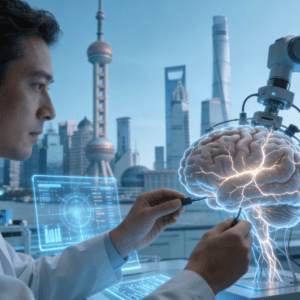
At its core, BCI establishes a direct communication channel between the brain and external devices, essentially acting as a “translator” for neural signals. It converts bioelectrical signals generated by the brain into machine-readable commands and, conversely, translates device feedback into perceptible neural signals, enabling bidirectional interaction of “reading” and “writing”. As one of the six future industries targeted in the proposals for the 15th Five-Year Plan, BCI technology aims to achieve collaborative interaction between biological and machine intelligence by creating an information pathway between the brain and machines.
Currently, mainstream global BCI technologies are mainly divided into two categories. Ming Dong, Vice President of Tianjin University, uses a vivid analogy to distinguish them: invasive technology is like “breaking through walls and approaching the city”—through surgery, microelectrode arrays are implanted into brain tissue or the epidural space to capture neuronal discharge signals at close range, boasting advantages of strong signals and high precision. Non-invasive technology, on the other hand, is like “hearing through walls and seeing through barriers”—using wearable devices such as headbands, earphones, and caps, it captures sub-microvolt-level EEG signals attenuated by thousands of times through the skull. Although slightly less precise, it is non-invasive, convenient, and low-cost, making it suitable for consumer and industrial applications.
From Medical Rehabilitation to Multifield Expansion
Medical rehabilitation is currently the most mature and core application field of BCI, as well as the key driving force for technological breakthroughs. Among China’s downstream BCI solution providers in 2023, 56% focused on the medical sector, mainly targeting the treatment and functional reconstruction of diseases such as post-stroke rehabilitation, spinal cord injury, amyotrophic lateral sclerosis (ALS), and epilepsy. Beyond the case of Mr. Li from Anhui, a hemiplegic patient who underwent rehabilitation, Li Zhi, a high paraplegic patient who received a fully implanted BCI surgery in October 2025, can now browse Bilibili and Xiaohongshu via thought, control smart homes and airbag gloves, transitioning from “being immobile and dependent on others” to “living independently with thought control”. In the field of neurocritical care, BCI has shortened the diagnosis time for hydrocephalus from several days to just half an hour, significantly reducing misdiagnosis rates and the economic burden on patients.
As the technology matures, BCI application scenarios are expanding from healthcare to consumer, industrial, aerospace, and other fields. In the consumer and health management sectors, non-invasive devices dominate, with product forms including sleep monitoring headbands and concentration training earphones, enabling functions such as sleep aid, emotional stress relief, and immersive AR/VR game interaction. In the long run, they are expected to become the “next-generation human-computer interaction portal”. In industrial scenarios, BCI combined with AI can monitor operators’ attention and fatigue levels in real time. In manufacturing, energy, agriculture, and other fields, models such as “BCI + drones” and “BCI + remote robotic arms” are pioneering new operation and maintenance models. Laboratories at Tianjin University have already achieved flexible drone flight control via EEG signals. In space exploration, the “eye-brain coordination” interaction system worn by Shenzhou-21 astronauts is being tested in the extreme space environment, expanding the boundaries of technological applications.
Looking ahead, the development of BCI will show a trend of “deepening medical applications, popularizing consumer use, and iterative technological advancement”. Every breakthrough in BCI is a vivid interpretation of technology for good.