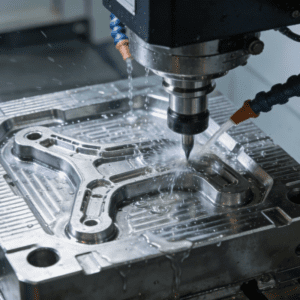
For manufacturers of life science components and medical device accessories, the machining of precision and complex parts is a core task in daily production. Examples include special-shaped curved parts of surgical instruments and high-precision interfaces of laboratory analysis equipment. The quality of these parts is directly related to the performance and safety of medical devices, with accuracy requirements often reaching the micron level. Market demand for such parts continues to grow, making them a key carrier of corporate competitiveness. However, traditional 3-axis or 3+2-axis machining often falls into a dilemma when processing these parts: repeated clamping leads to accumulated accuracy errors, tool angle restrictions make curved surface machining impossible, or cumbersome processes extend delivery cycles. Why is complex part processing always stuck? A 5-axis simultaneous machining center may be the key technology to break through the bottleneck.
Why Can’t Complex Part Processing Break Through the Bottleneck?
In the processing of medical device accessories, traditional 3-axis machining requires frequent fixture changes and workpiece angle adjustments. Each clamping introduces tiny errors, which may accumulate and cause products to fail to meet accuracy requirements. For example, machining a curved part for a surgical instrument requires 5–6 processes with 3-axis machining, which is not only time-consuming but also prone to dimensional deviation. In addition, when traditional machining handles special-shaped curved surfaces, the cutter cannot cut from the optimal angle, resulting in excessive cutting force, rapid tool wear, increased costs, and compromised surface finish. These problems directly restrict the quality improvement and production efficiency of life science components.
What Are the Core Differences?
The core difference between a 5-axis simultaneous machining center and traditional machining lies in motion axis control. Traditional 3-axis machines only control three linear axes (X, Y, Z), while 3+2-axis machines perform fixed-angle machining with preset angles. In contrast, 5-axis simultaneous machining adds two rotary axes, enabling real-time adjustment of workpiece or tool angles to achieve continuous machining of complex curved surfaces. The direct effects of this difference are: 5-axis simultaneous machining reduces clamping times and can even complete the entire part in one setup, whereas traditional machining requires multiple clampings; 5-axis simultaneous machining provides optimized tool paths for higher cutting efficiency and less wear, while traditional machining suffers from low efficiency due to unreasonable paths.
How to Achieve High-Precision Curved Surface Machining?
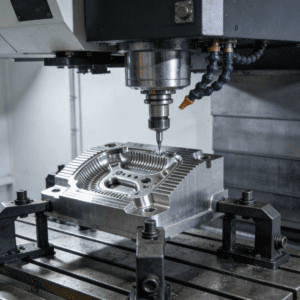
A 5-axis simultaneous machining center controls the movement of five axes (three linear axes + two rotary axes) at the same time, allowing the tool to approach the workpiece from any direction. During machining, the system calculates the tool position and angle in real time based on the 3D model of the part, ensuring the cutter always cuts along the tangent direction of the curved surface. This dynamic adjustment capability enables it to complete complex curved surface machining that traditional methods cannot achieve. Meanwhile, the machine is equipped with a high-precision servo system and CNC system, with positioning accuracy up to the micron level, fully meeting the strict requirements of medical device accessories.
Comprehensive Optimization from Efficiency to Cost
By choosing a 5-axis simultaneous machining center, enterprises can gain multi-dimensional advantages. First, reducing clamping times lowers human errors and improves product consistency and stability, which is critical for medical device accessories. Second, optimized tool paths shorten processing cycles, helping enterprises respond faster to customer needs. Third, tool wear is reduced by 30%, extending service life and lowering costs. In addition, the high degree of automation reduces manual intervention and eases labor pressure. Its core components are made of high-quality materials for high durability and low maintenance costs; the enterprise’s R&D capabilities support customized adjustments for special needs in the life science field, and reliable solutions have been provided to many medical device manufacturers.
An Inevitable Choice for Future Machining
With the rapid development of the medical device and life science industries, demand for high-precision complex parts is increasing. According to industry reports, the global market size of 5-axis simultaneous machining equipment will grow at a rate of 12% per year in the next five years, with a growth rate of 15% in the medical device field. This trend stems from the unique advantages of 5-axis simultaneous machining in solving the pain points of traditional processing and its significant effects on improving product quality and efficiency. For life science component manufacturers, adopting 5-axis simultaneous machining has become an inevitable choice to maintain competitiveness.
Choose 5-Axis Simultaneous Machining and Start a New Journey of Precision Manufacturing
With the characteristics of high precision, high efficiency, and high flexibility, 5-axis simultaneous machining centers have become an ideal solution to the pain points of complex part processing. For enterprises in the life science and medical device industries, adopting this technology can not only improve product quality but also reduce costs and enhance competitiveness. In the current market environment, customer requirements for accuracy and delivery time are becoming increasingly stringent, and traditional machining can no longer meet them. By dynamically adjusting the tool angle, 5-axis simultaneous machining achieves one-time processing of complex curved surfaces, fundamentally solving the problems of traditional machining.
What is the market price of a continuous motion multi-piece special-shaped machine?