
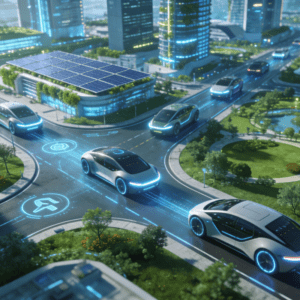
Technology is the foundation of smart city operation.
In addition to 5G, which has become a key technology for smart cities due to its unique features, smart cities also rely on a series of synergistic technologies for better resource management.
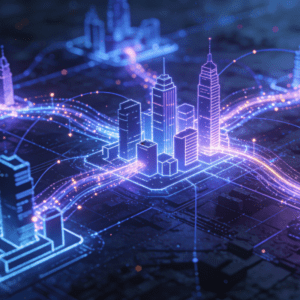
Through the Internet of Things (IoT), smart cities connect sensors and devices across the entire urban area to collect real-time data on transportation, waste management, weather and other aspects.
All such data is collected and organized using big data technology, and stored through edge computing and cloud computing for quick access. Artificial intelligence (AI) processes this data to optimize urban processes and services, such as public security, transportation and energy. Technologies like blockchain are applied to information management to ensure the security of all collected and generated data.
All these technologies together form a system that can automatically adapt to the ever-changing needs of smart cities.
The Role of Artificial Intelligence in the Development of Smart Cities
Artificial intelligence can be regarded as the brain of smart cities. It is this technology that optimizes and automates various urban services in a dynamic and efficient manner.
It can interpret transportation data and generate optimal solutions through intelligent traffic lights and route optimization, thereby reducing traffic congestion and emissions. It can also predict incidents by analyzing surveillance camera footage and people flow density sensors, dynamically enhancing urban public security. Furthermore, it plays a pivotal role in energy conservation and emergency service response.
In this way, artificial intelligence actively participates in all activities of smart cities and endows them with predictive and adaptive capabilities.
The Most Impactful Aspects of Smart City Development on Urban Daily Life
The aspects of daily life that smart cities can improve most directly include:
More efficient public transportation that better adapts to demand
Easier personal travel thanks to optimized routes and traffic signal control
Reduced pollution, cleaner air and less noise
Simplified administrative procedures
Safer public places enabled by video surveillance and dynamic resource allocation based on demand detected by sensors
Improved waste and resource management
Lighting and public services adjustable according to actual needs
Advantages of Smart Cities
Besides promoting energy conservation, enhancing quality of life and advancing sustainable development, smart cities can attract talent and technological investment, and create high-skill job opportunities, thus driving innovation and economic growth.
The use of digital tools also strengthens citizen participation and process transparency. These tools can also provide more personalized cultural and tourism experiences, enriching urban life.
How Different Will Tomorrow’s Cities Be from Today’s?
Cities of the future will be vastly different from our current perception of urban areas.
Automation will play a key role in daily life, with intelligent systems managing transportation, energy, public security and other sectors quickly and almost invisibly. This will cut costs and reduce environmental impact.
Mobility will be electric, autonomous and shared, leading to smoother traffic, shorter travel times, less pollution and lower noise levels.
Urban environments will incorporate more green spaces, sustainable infrastructure and people-oriented design.
Public governance will operate in an increasingly digital environment, which will simplify processes, boost transparency and encourage citizen participation.
In a word, cities of the future will be more interconnected and committed to making people’s lives more convenient.
What Are the Benefits of Coordination and Cooperation Among Different Smart Cities?
Coordination and cooperation between smart cities will facilitate the sharing of data and best practices, helping to learn from both successful and unsuccessful experiences and thus optimize resources—because the experience and data of neighboring cities can be applied to one’s own.
In addition, it is essential to ensure the interoperability of services, allowing citizens to travel between cities without having to use multiple platforms for a better experience. Such coordination also helps establish common security and privacy standards, and promotes the replication of successful projects from one city to another, among other benefits.