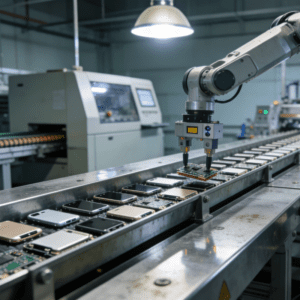
In the era of agile manufacturing, more and more enterprises are shifting from mass production to multi-variety, small-batch production. However, the traditional vibratory feeder has become a bottleneck restricting production efficiency—its poor compatibility, cumbersome changeover, and high risk of material jamming and damage often lead to prolonged downtime, increased costs, and failure to meet the flexible production needs of modern factories. As a key equipment in non-standard automation systems, the Flexible Vibratory Feeder (also known as Flex Feeder) solves these pain points perfectly, becoming an indispensable core component for automated production lines in 3C electronics, automotive parts, medical devices, and injection molding industries.
What Is a Flexible Vibratory Feeder? Breaking Through the Limitations of Traditional Feeding Equipment
A Flexible Vibratory Feeder is an advanced intelligent feeding device integrated with vibration technology, machine vision, and robotic collaboration. Different from the fixed track and single-material feeding mode of traditional vibratory feeders, it uses a flexible tray and adjustable vibration parameters to realize orderly sorting and conveying of various irregular, small-sized, and easily damaged materials without replacing hardware components. Its core working principle is similar to the traditional winnowing dustpan—by controlling the voice coil motor to generate precise vibration, adjusting the frequency and amplitude, the materials are shaken and turned to the optimal grabbing posture, and then the visual system locates the qualified materials and guides the robot to pick them up accurately, forming a fully automated feeding closed loop.
Compared with traditional vibratory feeders, the Flexible Vibratory Feeder has subverted the traditional feeding logic: it does not rely on fixed tracks to sort materials, but uses software adjustment to adapt to different materials, which fundamentally solves the problems of traditional feeders such as long changeover time, high customization cost, and easy material damage. It is precisely this flexibility that makes it the first choice for non-standard automation feeding scenarios, especially for enterprises that need to switch between multiple product specifications frequently.
5 Core Advantages of Flexible Vibratory Feeder: Why It’s Essential for Non-Standard Automation
For enterprises engaged in non-standard automation, the value of a Flexible Vibratory Feeder lies not only in “feeding materials” but also in “improving efficiency, reducing costs, and adapting to changes”. Its core advantages are perfectly aligned with the pain points of modern manufacturing:
- High Compatibility: One Machine for Multiple Materials
It can handle materials of various shapes, sizes, and materials—whether it is small electronic components (such as connectors, inductors), precision hardware parts (such as screws, gaskets), injection-molded plastic parts, or fragile thin-sheet materials, it can be easily adapted by adjusting vibration parameters and visual templates, without the need to customize separate feeding equipment for each material. This not only reduces the initial investment cost of equipment but also saves the storage space of multiple traditional vibratory feeders.
- Rapid Changeover: Shorten Downtime Significantly
In multi-variety mixed-line production, rapid material switching is the key to improving production efficiency. The Flexible Vibratory Feeder has built-in multiple sets of material parameter programs. When switching products, operators only need to click to call the corresponding program, and the equipment can quickly adjust the vibration frequency, amplitude, and material arrangement mode, shortening the changeover time from several days (traditional vibratory feeder) to 5-10 minutes. For enterprises with frequent product updates, this advantage can increase production efficiency by 30%-50%.
- High Precision & Damage-Free Feeding: Ensure Product Quality
Equipped with advanced AI visual positioning technology, the positioning accuracy can reach ±0.02mm, which can accurately identify the posture of materials and guide the robot to pick them up, avoiding the error of manual feeding and ensuring the stability of the subsequent assembly process. At the same time, the soft vibration mode and customizable anti-wear, anti-static tray can gently vibrate materials, avoiding scratches and damage caused by friction between materials and equipment, which is especially suitable for high-precision and fragile materials such as microchips and medical components.
- Cost Saving: Reduce Long-Term Operating Costs
The modular design of the Flexible Vibratory Feeder reduces the wear of mechanical parts and the failure rate, thereby reducing maintenance costs and downtime. In addition, its high reusability avoids the waste of equipment caused by product iteration (traditional vibratory feeders often need to be scrapped when the product is updated), and the one-time investment can be recycled in a short time through efficiency improvement and cost reduction. According to actual customer cases, the use of Flexible Vibratory Feeder can reduce labor costs by 60% and material waste rate by 80%.
- Easy Integration: Adapt to Various Non-Standard Automation Lines
As a core component of non-standard automation systems, it can be seamlessly integrated with various robots (such as Epson 6-axis robots, SCARA robots), assembly machines, and inspection equipment, supporting TCP/IP communication and passive I/O port triggering, and can be flexibly configured according to the layout of the production line and production needs. Whether it is a single-station feeding station or a multi-station integrated production line, it can be perfectly adapted, helping enterprises quickly build flexible automation systems.
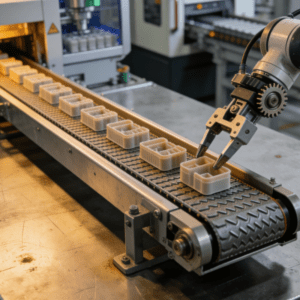
Industry Application Scenarios: Where Can Flexible Vibratory Feeder Play Its Role?
With its strong flexibility and adaptability, the Flexible Vibratory Feeder has been widely used in various non-standard automation fields, solving the feeding pain points of complex scenarios. Typical application scenarios include:
- 3C Electronics Industry
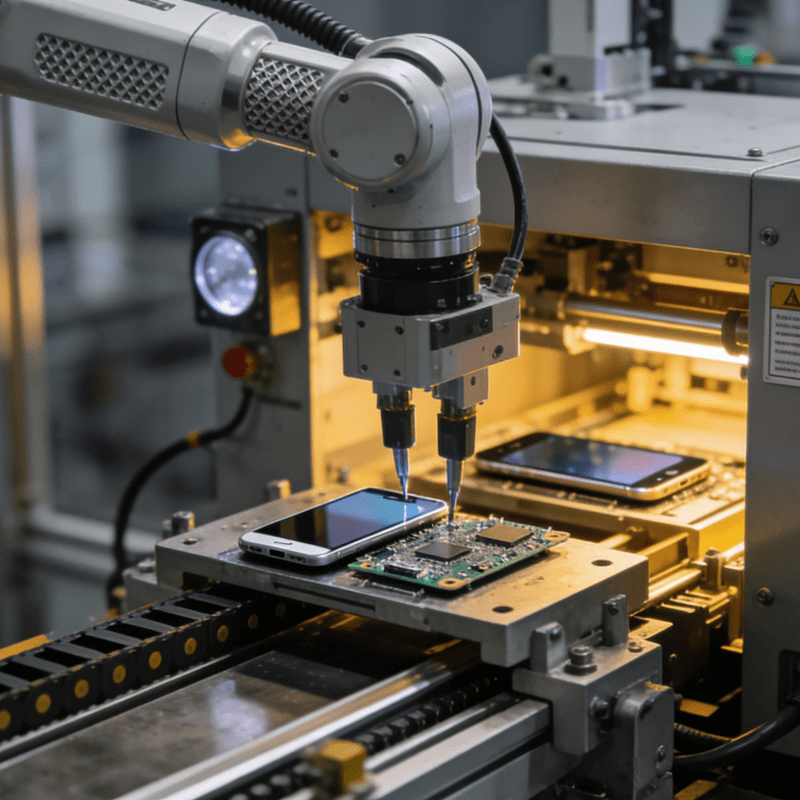
It is used for feeding micro-components such as mobile phone connectors, FPC cables, and camera modules. The damage-free feeding mode ensures the surface quality of precision components, and the rapid changeover capability adapts to the fast iteration rhythm of 3C products. It can reduce the defective rate from 1.2% to 0.05% for 0.4mm pitch chip pin feeding.
- Automotive Parts Industry
It is used for feeding hardware, O-type rubber seals, and engine cylinder head bolts. The composite vibration frequency can effectively disperse sticky rubber parts, and the visual positioning ensures the correct posture of parts, realizing the automated feeding of automotive parts assembly lines with a beat of up to 1200 pieces per hour.
- Injection Molding Industry
It is matched with injection molding machines to realize automatic feeding of plastic parts. It can adapt to different shapes and sizes of injection molding products, avoid material jamming caused by irregular plastic parts, and connect with the packaging machine to form a full-process automation line for injection molding and packaging.
- Medical Device Industry
It is used for feeding medical components such as syringes and medical gaskets. The cleanroom-grade design (complying with ISO 14644 cleanroom certification) and food-grade anti-stick tray (complying with FDA certification) ensure that the feeding process meets medical hygiene standards, avoiding secondary pollution of materials.
How to Choose the Right Flexible Vibratory Feeder for Your Non-Standard Automation Line?
There are many types of Flexible Vibratory Feeders on the market, and choosing the right product according to your own production needs is the key to exerting its maximum value. Here are 4 core selection principles for non-standard automation enterprises:
① Focus on Customization Capability: Choose a manufacturer that can provide non-standard customization services, and customize the tray size, vibration parameters, and visual system according to the size, material, and feeding requirements of your materials, so as to ensure that the equipment is perfectly matched with your production line;
② Pay Attention to Integration Compatibility: Confirm whether the equipment can be seamlessly integrated with your existing robots, injection molding machines, and other equipment, and support remote monitoring and debugging to reduce later operation and maintenance costs;
③ Evaluate After-Sales Support: The Flexible Vibratory Feeder involves the coordination of vibration, vision, and robot systems, so it is necessary to choose a manufacturer with perfect after-sales service, including on-site installation, commissioning, operator training, and 12-month warranty and long-term spare parts supply;
④ Refer to Industry Cases: Prioritize manufacturers with rich experience in your industry. For example, if you are engaged in the injection molding industry, choose a manufacturer that has successfully delivered injection molding feeding solutions, which can avoid the risk of inappropriate equipment selection.
Your Trusted Flexible Vibratory Feeder Partner for Non-Standard Automation
As a professional non-standard automation solution provider, we focus on the R&D, customization, and integration of Flexible Vibratory Feeders, and have accumulated rich experience in 3C electronics, automotive parts, injection molding, and other industries. Our Flexible Vibratory Feeder has the following unique advantages:
Full non-standard customization: According to your material characteristics, production capacity, and production line layout, customize the overall solution, including tray design, vibration parameter debugging, and visual system matching;
High integration performance: Seamless integration with various robots and automation equipment, supporting remote monitoring and one-click debugging, reducing operation difficulty;
Strict quality control: Each equipment has passed strict load testing, precision testing, and noise testing (noise ≤55dB, complying with ISO 3744 acoustic certification), ensuring stable operation in long-term production;
Perfect after-sales service: Provide 24-hour online technical support, on-site installation and commissioning, and operator training to solve your worries in the later use process.
Whether you need to solve the feeding problem of multi-variety, small-batch production, or want to improve the automation level of your production line and reduce costs, our Flexible Vibratory Feeder can provide you with a tailored solution. Visit our website to view more industry cases and product details, or contact our engineering team directly to get a free customized quotation and technical consultation!
Keywords: Flexible Vibratory Feeder, Flex Feeder, non-standard automation, multi-variety small-batch feeding, robot integrated feeding, injection molding feeding equipment, 3C electronic feeding solution