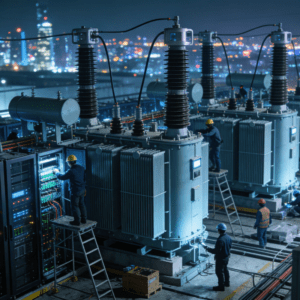
As the global AI race entered a white-hot phase in 2024–2025, an ostensibly traditional industry has been experiencing unprecedented prosperity: the power equipment manufacturing sector. With the explosive growth of generative AI technologies such as ChatGPT and Sora, global data center construction has entered an “arms race” mode. The power equipment that sustains these “computing power factories” has become a more sought-after strategic resource than chips.
The International Energy Agency (IEA) forecasts that global electricity demand from data centers and AI could double by 2026. Data from Stanford University shows that training the GPT-3 model alone consumes as much as 1.287 million kWh of electricity. In this computing power revolution, power equipment including transformers, switchgears, and UPS systems are no longer supporting infrastructure, but have become critical bottlenecks restricting AI development. When Elon Musk warned at Bosch Connected World 2024 that “you will see power shortages next year,” global capital markets had already keenly captured this signal: the power equipment sector is embracing a once-in-a-decade “super cycle.”
Explosive Demand: A Qualitative Restructuring of Power Equipment Demand
Exponential Surge in Per-Rack Power
The power demand of AI data centers differs drastically from traditional data centers. Conventional data centers typically run at 5–10 kW per rack, while new generation AI data centers have jumped to 40–100 kW per rack, with some supercomputing clusters exceeding 150 kW. This means the instantaneous load of a medium sized AI park is close to that of an industrial zone or even a small city.
This surge in power density has triggered three direct knock on effects:
Insufficient grid access capacity, with existing power distribution facilities unable to meet demand.
Ultra high requirements for power supply stability, where any outage can cause losses in the millions.
Backup power shifting from an “option” to a “must have.”
Against this backdrop, transformers have evolved from “basic equipment” to core nodes of computing power infrastructure.
Eaton projects that the data center driven electrical equipment market will grow at a 16% CAGR from 2022 to 2025. More tangibly, a 100 MW intelligent computing center requires supporting 450 MVA of transformers—4.5 times the demand intensity of conventional scenarios.
The Global “Transformer Shortage”
The skyrocketing demand for power equipment has evolved into a global supply crisis. The U.S. market is representative:
Average lead times for large power transformers in the U.S. have stretched from 50 weeks to 127 weeks.
Some data center specific models have lead times close to 3 years.
The transformer shortage for AI data centers in North America reaches 80%, with prices generally rising by more than 60%.
European customers are even willing to pay a 20% premium to secure supply.
This suppl demand imbalance reflects a global “capacity restructuring” and “pattern reshaping” in the power equipment industry. Core transformer components such as large iron cores and high voltage coils involve complex manufacturing processes and are constrained by high end talent and specialized equipment. Capacity expansion lags far behind demand growth. Rystad Energy judges that the tight global supply demand situation for transformers will persist until the end of 2026, and may extend further.
Surging Performance: A “Golden Age” for Power Equipment Manufacturers
Surge in Orders for Domestic Manufacturers
Chinese power equipment manufacturers are among the biggest beneficiaries of this global computing power revolution.
Early 2025: orders at Guangdong Zhongpeng Electric Co., Ltd. surged by 70–80% year on year, with production lines running at full capacity 24/7.
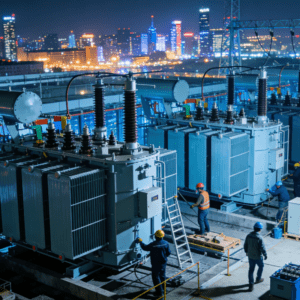
Containers loaded with transformers outside Shunte Electric and other firms wait to be shipped to data centers worldwide.
Igor’s data center related products saw orders surge by more than 400% in 2025.
According to Dongfang Wealth research:
Jan–May 2025: China’s power transformer exports reached 16.464 billion yuan, up 46.22% year on year.
Switch exports: 1.960 billion yuan, up 27.26%.
Cable exports: 9.050 billion yuan, up 36.75%.
Stellar Financial Reports from Leading Companies
From a capital market perspective, the power equipment sector has become a key target for capital inflows.
February 2025: While the A share market trended sideways, grid equipment sectors including UHV, power grid devices, and flexible DC transmission strengthened against the market.
Grid ETF (561380) rose more than 2%, with over 1.7 billion yuan of net inflow in 20 days.
Outstanding performers:
Sieyuan Electric: overseas revenue up 45% in 2024.
Samsung Medical: overseas revenue up 38% in 2024.
Pinggao Electric: high voltage equipment business up 71% in 2024.
Xuji Electric: intelligent informatization business up 102% in 2024.
An A share listed company in data center power supplies (believed to be Autoxun or similar) forecasts 2025–2027 revenue in this segment at 1.034 / 2.091 / 3.873 billion yuan, with growth rates of 54.7% / 102.20% / 85.2%.
Market Opportunities for Overseas Giants
Global power equipment giants have also benefited:
Eaton: Q4 2024 power related orders reached $11.8 billion, up 27% year on year. Data centers account for 17% of industry revenue, with $1.2 billion in orders over 12 months, securing three years of future revenue. Double digit growth is expected from 2024 to 2030.
Siemens Energy: over 50% market share in Europe, Middle East, and Africa. 2025 grid tech revenue growth guidance raised to 24–26%. Grid businesses are set for at least double digit growth.
Broadcom: Q3 fiscal 2025 revenue $15.95 billion, up 22% year on year. AI semiconductor revenue hit $4.1 billion, up 77%. It expects AI semiconductor revenue to rise to $4.4 billion in the next quarter.
Technological Upgrading: From Traditional Equipment to Smart Power Systems
Rising Penetration of High Voltage Direct Current (HVDC)
In data center power architectures, HVDC is gradually replacing traditional UPS systems. HVDC offers high efficiency, small footprint, and high reliability, making it ideal for high power density AI data centers. Rising HVDC penetration, paired with surging AIDC investment, will drive market expansion.
A leading domestic power equipment supplier deeply bound to top cloud vendors is expected to see its gross margin in data center power supplies rise from 21.46% in 2025 to 26.55% in 2027 as overseas sales increase.
Power Support Demand for Liquid Cooling Technology
As AI chip power density climbs, liquid cooling has become a necessity rather than an option. Liquid cooled data centers demand:
Higher power capacity
More precise power monitoring
Smarter power distribution management
This drives demand for high end products such as intelligent PDUs and precision power distribution cabinets.
Sugon Digital Innovation, a liquid cooling infrastructure provider, saw H1 2023 revenue and net profit rise by 58.25% and 56.89% year on year, demonstrating strong momentum in the computing power infrastructure chain.
Intelligent and Digital Upgrading
AI data centers require far higher intelligence in power systems than traditional facilities. Intelligent power distribution systems need real time monitoring, predictive maintenance, and automatic fault switching, driving deep integration of power equipment with IoT, big data, and AI.The growth of companies such as NR Electric and State Grid Information & Telecommunication in smart grids and power informatization reflects this trend.
Industrial Chain Restructuring: From Equipment Suppliers to Energy Solution Providers
Accelerated Domestic Substitution
The power equipment sector is witnessing historic opportunities for domestic substitution.
State owned operators and enterprises mostly choose domestic brands for self built data centers.
As foreign firms slow investment in UPS and lead acid batteries, Chinese manufacturers are capturing more incremental demand.
New technologies are expected to further expand domestic market share.
Successful Global Expansion
Chinese power equipment firms are reaping rewards from globalization.
2025: China’s transformer exports reached 64.6 billion yuan, up nearly 36% year on year, a record high. Europe and North America were the main growth drivers.
Tgood signed a 700 million yuan contract with Saudi State Grid for high voltage mobile substations, marking a breakthrough in high end overseas markets.
Exports now include not only products but also technical standards and solutions.
Rise of Industrial Clusters
Cities such as Foshan are seizing opportunities to build a “new power equipment corridor.”
Foshan launched a three year grid investment doubling plan.
By 2025, it has introduced 50 key projects including Chint South China Headquarters and Shanghai Electric power transmission & distribution equipment.
More than 4,000 power equipment related enterprises are now clustered there.
The Pearl River Delta, Yangtze River Delta, and Beijing Tianjin Hebei region are all racing to position themselves in UHV, flexible DC transmission, and other cutting edge tracks.
Challenges and Risks: Hidden Worries Behind Prosperity
Capacity Bottlenecks and Delivery Pressure
Despite full order books, manufacturers face severe capacity constraints. Transformer production involves complex processes, and capacity takes 1–2 years to ramp up, making rapid expansion difficult in the short term.While tight supply boosts prices and margins in the short term, it may push customers to alternatives such as modular substations and distributed energy systems, or suppress demand.
Fluctuations in Raw Material Prices
Key raw materials—copper, silicon steel, insulation materials—directly affect gross margins. Global inflation and supply chain restructuring in 2024–2025 have increased operational risks.
Technological Iteration Risks
AI and data center technologies evolve rapidly. Shifts from air cooling to liquid cooling, centralized to distributed architectures, can drastically reshape demand structures. Manufacturers must stay agile.
Uncertain Policy and Standards
Energy policies, carbon emission rules, and grid access standards vary by region.
EU stricter transformer efficiency standards
U.S. Inflation Reduction Act favoring domestic manufacturing
All reshape competitive landscapes.
Future Outlook: Sustainability of the Super Cycle
Long Term Demand Support
According to Huawei’s forecast:
2030 global general computing (FP32): 3.3 ZFLOPS, 10× 2020 level.
2030 global AI computing (FP16): 105 ZFLOPS, 500× 2020 level.
This exponential growth will continuously drive data center construction and power equipment demand.Meanwhile, the global energy transition is deepening from power generation to grid modernization, requiring upgrades across transmission, distribution, and end user equipment.
Supply Side Capacity Release
Major transformer manufacturers are accelerating capital expenditure and capacity expansion.While the overall supply crunch may ease in 2026–2027, structural shortages (high end large capacity transformers, data center specific equipment) are expected to persist.
Direction of Technological Evolution
Future power equipment will develop toward:
Higher efficiency: amorphous alloy transformers, stepped wound core transformers.
Greater intelligence: integrated sensors, communication, edge computing.
Greener performance: natural ester insulation oil, low noise, recyclable materials.
Modularity: prefabricated substations, modular UPS for fast deployment.
Conclusion: At the Intersection of Energy and Computing Power Revolutions
The boom in data centers has driven windfall profits for power equipment manufacturers, marking a historic convergence of the energy revolution and the computing power revolution.As AI becomes the new engine of productivity, electricity is the “new oil,” and power equipment is the “new drill” that extracts and delivers it.
For power equipment manufacturers, this is both a rare historic opportunity and a severe challenge:
Opportunities: a oncein a decade super cycle, strong demand, technological upgrading, domestic substitution, and vast global markets.
Challenges: capacity bottlenecks, raw material volatility, rapid tech iteration, and policy uncertainty.
Going forward, data center power demand will grow sustainably. Manufacturers must seize the moment, increase R&D, optimize capacity, expand scenarios, and transform from pure equipment suppliers into comprehensive energy solution providers to gain an edge in the new infrastructure wave of the computing power era.
As one industry analyst put it:”In a gold rush, the people who sell shovels often earn more than the gold miners.”
In this global AI computing power race, power equipment manufacturers are the true “shovel sellers”—and their golden age may have only just begun.